
REVIEW:
Temple of Desire – Karma Dance Inc.
Sydney Opera House
4 June 2026
***
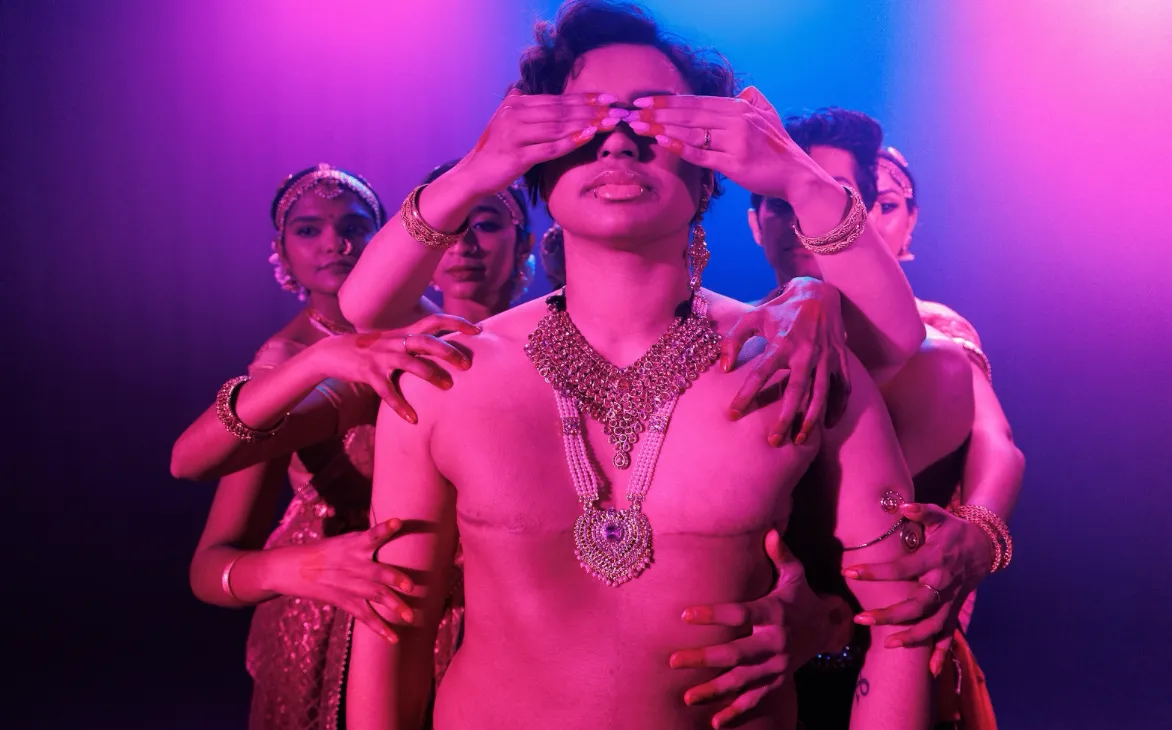
Temple of Desire by Karma Dance Inc. is a contemporary theatre work performed by 21 dancers, superbly directed and choreographed mesmerizingly by Govind Pillai (pictured with reviewer, below). The work explicitly centres queer, trans and women’s experiences, while presenting desire, not as something sinful, but as a pathway toward liberation.

Firmly grounding itself in Indian sub-continental tradition, Temple of Desire celebrates and interrogates the spiritual philosophy of Sanāthana Dharma, and the movement vocabulary of the ancient classical dance form of Bharatanātyam. The rhythmic adavus, clear mudras and the sculptural articulation of the body signal an expert engagement with the classical tradition. The performance’s expressive register reimagines pre-colonial understandings of spirituality, gender and sexuality while simultaneously drawing upon abhinaya in ways that feel recognisably devotional.

In its organisation of time and structure, Temple of Desire departs from the traditional expectation. Sequences shift rapidly between states, moods and spatial configurations, often foregoing gradual unfolding through the extended, cyclical choreography typically associated with orthodox Bharatanātyam compositions. This creates a sense of fragmented dramaturgy, which might be described as a contemporary rhythmic discontinuity running through a classical body. Temple of Desire, therefore, is neither purely classical nor fully post-classical, but situated in an in-between fluidity.


The tensional ambiguity between form and structure, however, becomes one of the work’s defining characteristics. On the one hand, the integrity of classical choreographic technique remains visible and compelling; on the other, its recontextualisation within a contemporary performance frame produces moments of both vitality and disorientation. The audience is invited to recognise the lineage of the form while simultaneously experiencing its destabilisation. Therefore, the comfort of certainty is not something Temple of Desire affords its audience.


As someone familiar with Indian classical dance, I found myself both captivated and unsettled. This was certainly not because the performance lacked artistic conviction, but because it challenged many of the assumptions through which I have come to understand classical Indian dance.


Rather than resolving this tension, Temple of Desire appears invested in sustaining it. The result is a performance that challenges its viewers to reconsider what constitutes continuity within classical dance, and by extension the social politics of gender. It asks its audience if, like dance, is gender also located in vocabulary, structure, affect or something more fluid between these elements?


Ultimately, Temple of Desire occupies a space of productive ambiguity. It neither abandons convention nor preserves it in orthodoxy. Instead, it reimagines the form as something elastic, which is capable of holding contemporary sensibilities, without fully relinquishing its classical grounding. Whether one reads this as transformation or departure may depend less on the work itself and more on how one understands the boundaries of tradition, be it dance or gender.
5 out of 5 stars
Review by Sean Perera