IZZARD: THE TRAGEDY OF HAMLET
Fairfax Theatre, Victorian Arts Centre, Saturday 11 July, matinee show
5 out of 5 stars
Reviewed by Christos Linou
***
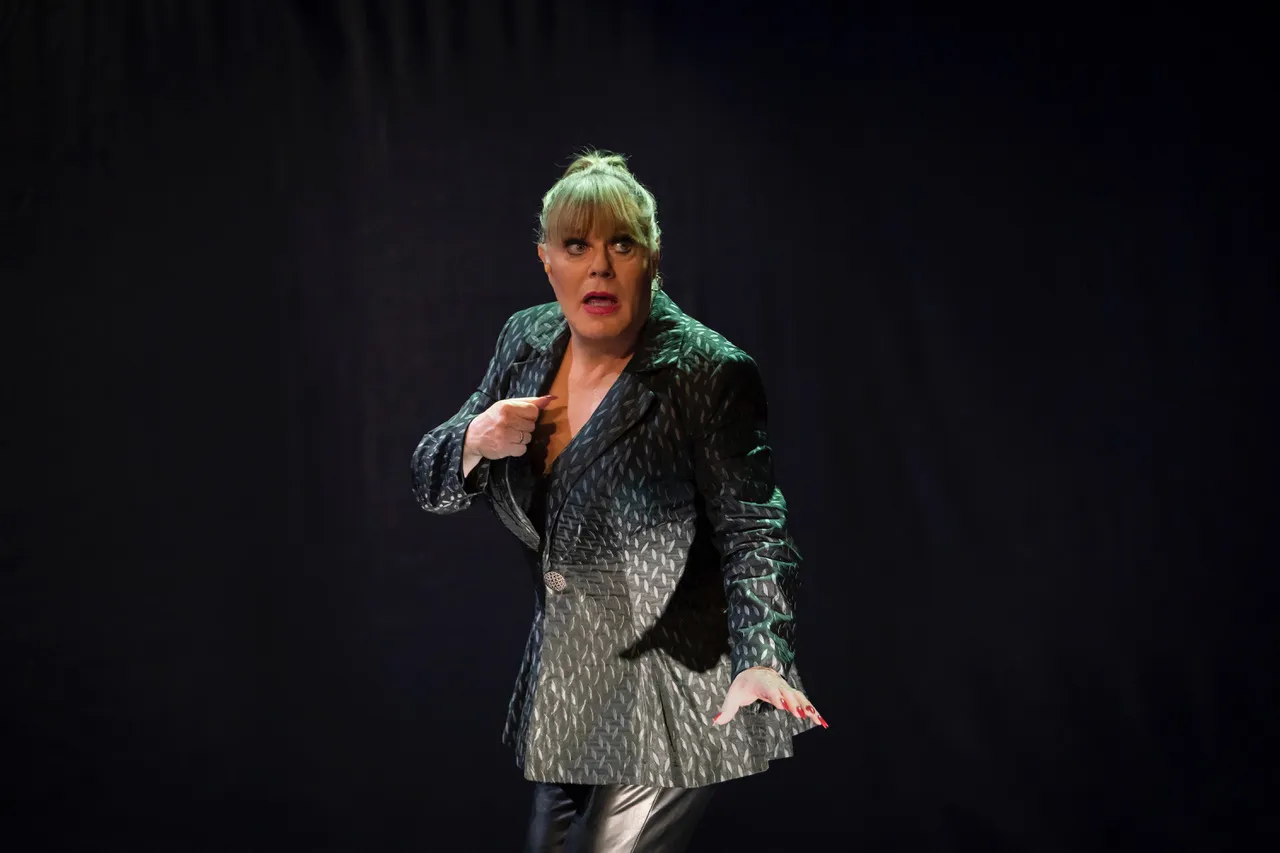
The performance of Izzard: The Tragedy of Hamlet was delivered with a gentle vocal punctuation and gracious restraint. With no special effects, no soundtrack, no props or ornamented stage and only the presence of a single body on stage, Izzard’s performance was magnificent as she transfixed the full-house auditorium of the Fairfax Theatre.
The set design allowed a close-up and intimate relationship between the performer and the audience. A single shaft of light on the back wall represented the in-between place of life and death; two floor lamps focused on Izzard, casting her shadows on either side of the walls as she moved in and out of the light. The shadows created a great flickering effect and reminded me of the darkness of one’s shadowy thoughts and the space metaphorically transformed into Plato’s cave, where talking to oneself in the dark leads to the self-examination of one’s sanity; that is, the lunacy of Hamlet! And I anticipate that during the play, Hamlet staring into the dark pits of an empty skull and asking, “To be or not to be, that is the question?”
Before the performance, Izzard casually introduced herself to the audience, which established the intimacy of her role in telling us the story of Hamlet as a transgender woman. Eddie clarified that yes, in the past she has been recognised as a male stand-up comedian and performed many leading roles as a masculine man in stage and screen. However, now he is she and is proudly happy to commit to being a genderfluid trans woman.
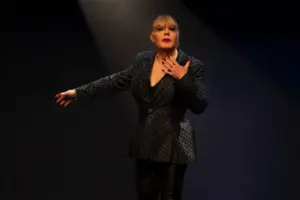
Once Eddie Izzard, now Suzie Izzard, she is a vibrant woman who performs on an unadorned stage to deliver a complex script of loss, love and war through the eyes of Shakespeare’s Hamlet. She embodies the entire cast and performs as a man, a woman, ghosts, scholars, tyrants, courtiers, lovers, fools and poets from the play. In the program notes, Izzard personally expresses:
“I’m playing 23 characters, men and women, and as a trans person, playing them with equal honour. When you’re jumping from character to character, and they’re in different places in their arcs, it’s challenging, it takes a lot of mental effort. But I’m loving doing it.”
Izzard delivered her voice with poised brutalist pitches with heartwarming hypnotic chants and sang parts of the script with delicate pauses and rhythmic wordplay with dramatic, choreographed gestures of white-knuckle gripping suspense. Her controlled, choreographed body staging altered the shape and size of her shadows on the back wall, referencing the madness of the characters. “Oh, Horrible most Horrible”, she sang, as the shadows on the back wall projected her female form and caught Izzard’s masculine shadow figure. All the while, I was watching a beautiful woman dressed as an almost dominatrix mistress in leather ankle boots and tights, with a single buttoned midriff jacket and humble laced blouse. Her hair was golden blonde and tied back into a short ponytail, which elegantly graced her long, lush eyelashes, with a soft touch of peach highlights under her eyes, highlighting her radiant, deep red lips and fiery red fingernails.
This would be a feast for playwright and director Peter Brook’s definition of ‘The Empty Space,’ where the focus dismisses the frills and spectacle of the Shakespearean Theatre and compels the audience to engage deeply with the performer and the intention of the act. Brooks states this in the opening of his book:
“A man walks across this empty space whilst someone else is watching him and this is all that is needed for an act of theatre to be engaged.”
The director Selina Cadell presents Hamlet on an empty stage, pushing Izzard’s ability as a complex actor into the darkness of Hamlet’s demons, enemies and lovers. Izzard addresses the intricacies of the script and we watch and listen, our imagination flourished with imagery conjured up by Izzard’s magnificence. Do we aimlessly float from chance and cause and effect through the dark abyss of the universe? Is there a God to speak through the empty eye sockets of a skull? Hamlet is searching for redemption but is trapped in a state of terror of the unknown. That is death and all that is imagined in a post-metaphysical world.
The relationship with ancient Greek tragedy within the realms of one with tragic flaws; hubris, hamartia and peripeteia, fits within the Aristotelian profile of the tragic hero, in that the protagonist (Hamlet) shifts from being brutally bad to beautifully good. In the Meditations of French Philosopher by René Descartes, “I think therefore I am,” also dovetails perfectly in the story of Hamlet. In Descartes’ thoughts, he considers imagination as a place to float through these dimensions of self: one of no limbs, no head, just thought; and without this flesh. He remarked:
“But what then am I? A thing that thinks. What is that? A thing that doubts, understands, affirms, denies, is willing, is unwilling, and also imagines, and has sensory perceptions.”
Izzard performed the work of Hamlet, without the supporting cast, and we imagined Izzard as all these complex characters. I, along with a packed auditorium in the Victorian Arts Centre’s Playhouse Arts Centre, witnessed a master of the arts in real time and in a state of anticipation of Izzard’s every next move and utterance. There are elements of alienation as Izzard abruptly interrupts Hamlet as a way of smashing through fact and reason. Hamlet is alienated from himself and his reasons cause his world to be one of madness, violence and insanity as he demolishes and destroys all he loves. Izzard relied purely on the empty space to forge the tension and suspense of the plot and transfixed the audience through her precise yet restrained body language to compel us into the swirling madness of Hamlet.
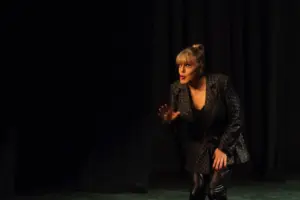
Is Izzard’s Hamlet of The Holy Theatre? I again take reference from Brooks Empty Space where he commits that this form of theatre is of reverence. The stage is reduced to the nuances of the actor and their strength is in delivering a dramatic plot with a cast of characters that we don’t see. Brooks defines this as the theatre of the invisible made visible and claimed:
“I am calling it the Holy Theatre, but it could be called the theatre of the Invisible-Made-Visible.”
Izzard’s performance is captivating how she embodies the emotions and physicality of each character to portray the idiosyncratic details of the plot. And all are drawn into Izzard’s powerful control and command of the stage that allowed the invisible in the plot to be imagined.
From the ancient shadows of Plato’s cave to Descartes’ “I think therefore I am,” and the spectres of the supernatural, Izzard’s Hamlet is filled with humanity’s questions of reason and doubt that fit perfectly with Izzard’s reasoning to present a work that questions and justifies humanity’s notion of hope, dread and the joys and sorrows we all possess in the relevance of one’s life.
Izzard performed the work with gentle gestural hand dancing in a ballroom style with impact and stillness; pirouetting seamlessly from character to character and slipping into deep states of trance to occupy the ghosts and omens of Hamlet’s disastrous treachery, torment, purgatory and confessional redemption. Izzard forcefully grunts, hums, huffs and puffs and then soothes the space with a wooing melody and songs from the other side. Then turns to the audience and whispers, “Death will come to all – To dream, to sleep, to death.”
I especially liked the sword-fighting scene where Izzard bellowed grunts, groans, ahhhs, ohhhs and whooshes as she mimed the actions of killing and being killed. Dramatic comic relief and slapstick vaudevillian light relief at its best, which pronounced the master of the artist. I was in awe and thought, as a choreographer/dancer with four decades of performing arts experience, and I’m privileged, sitting here in the auditorium, so close to Izzard. I felt like a student watching a personal workshop in performance excellence. If Izzard didn’t say a word from the script and performed only the actions of the play, the performance could be seen as a contemporary choreographic dance work: ‘Hamlet’s dance of death.’
The grave scene near the finale of the play was where everything jumped out and revealed the reasoning and madness of Hamlet as Izzard jolted from the austere logos of the Queen’s English into the grave digger’s comic, cocky vocabulary idioms on life. It was hilarious that I identified the brilliance of Izzard and her ability to jump from deep, tragic drama to dark comic relief.
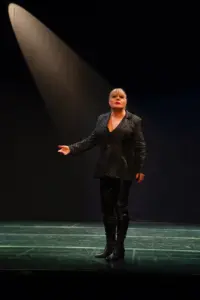
Who has the power of attention and grace to captivate a full house of theatre goers’ intent fixed on the words and actions of the actor in a one-person performance dressed as a woman; or is she dressed as a Shakespearean man dressed as a contemporary woman? Suzie Izzard has. Izzard’s strength in her self-assurance and the embodiment of her gender fluid body politic where personal resilience, ethical morality, empathy and compassion are galvanised into loving hope for the human spirit.
I ask, why present a story of a tragic hero in a time of controversial unreasoning, where there are multiple conservative opinions about transgender people? And I realised this is poignant work. It resides within the challenges of the trans community, who are considered outcasts and a taboo on the morality of humanity by the conservative agitators of ignorance. For example, the flock of followers behind Pauline Hanson’s ugly One Nation rhetoric that are prostituting the use of ‘free speech’ to argue about social morality.
Izzard’s performance takes the attention away that she is a trans woman and reveals the desires of self through the victims of Shakespeare’s Hamlet. Shakespeare’s plays were a mirror to society that continues to resonate today. His plays were considered a ‘freedom of speech’ and a safe place of social protest where the common person, alongside the monarchy, would be invited to criticise their actions, to understand changing ideologies. Hamlet was said to be first performed in 1601. Queen Elizabeth 1 was a great patron of the arts who sponsored and encouraged playwrights to freely explore their creative ideas, free from religious dogma.
Izzard boasts an enormous career in the performing arts, film, TV and stage with a track record of awards. I can remember seeing films when she was he. I was drawn into his deep, beautiful and gallant handsome masculinity, and now she stands ever-present in a paramount of graciousness and humble beauty.
Izzard is an activist for human rights, equality and political transparency. Behind the glamour of red carpets, bright lights and notoriety, Izzard is a hard-working woman raising millions of dollars for charity through her incessant need to run marathons to de-stigmatise body shaming and those of difference, as personal record-breaking events. I was privileged to witness a canon of a performer with a master of performative storytelling. When she took her curtain call, the audience erupted and a standing ovation humbled Izzard and she personally thanked us and explained:
“My mother would be very happy with it. She died when I was six years old and she was a performer and a singer, so I’m channelling her voice today.”
Izzard has an awe-inspiring energy and has presented this outstanding, physicality/mentally demanding one-person performance on the back of her Australian tour. The season of Hamlet continues, as Izzard performs her compelling work at Perth’s Heath Ledger Theatre at the State Theatre Centre of WA on from July 27 to 29 July and then the Canberra Theatre from July 31 to August 1.