REVIEW:
TIP TOE
(Binge)
4 out of 5 stars
Tip Toe arrives as a five-part alarm bell – and a mirror held up to a world where queer lives have become contested ground all over again.
Russell T Davies, the man behind Queer as Folk, It’s a Sin and Doctor Who, has said he has never written anything so furiously, and you can feel the heat coming off Tip Toe. It arrives carrying an urgent question that has stopped being rhetorical: if inclusion and representation are now a given, what happens when other people simply don’t like what they see?
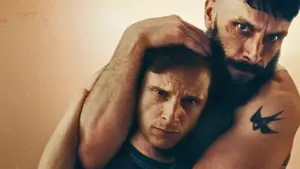
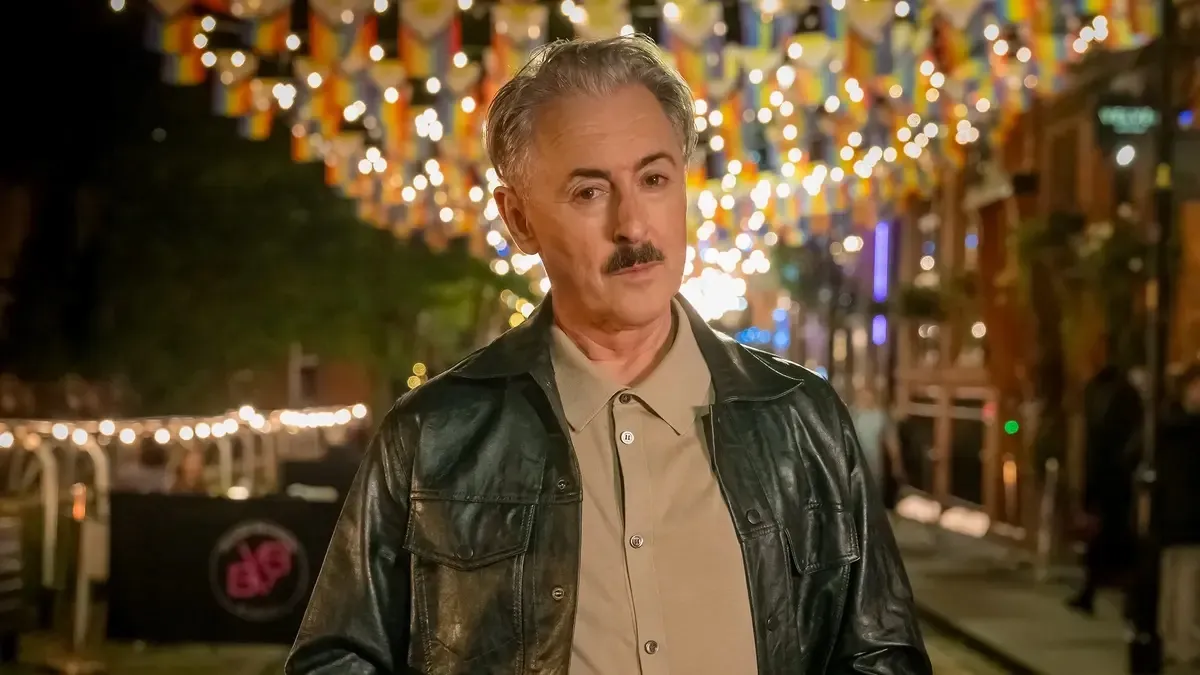
On the surface, the five-part Channel 4 drama begins with something almost mundane: a neighbourly dispute. Leo, played by Alan Cumming, is a gay bar owner on Manchester’s Canal Street. Clive, played by David Morrissey, is his reserved, reticent, quietly judgmental neighbour. Their feud begins with Leo asking Clive for help after being locked out of his house. It is an ordinary request, the kind of interaction that should pass without consequence. But in Tip Toe, as in life, the ordinary is often where danger first announces itself.
This is where Davies’ decision to make Tip Toe a neighbour story feels so potent. Hate is often discussed as if it belongs elsewhere: to extremists, mobs, dictators, online trolls, faraway legislatures. But for LGBTQ+ people, danger is frequently intimate. It is the person at the next table. The parent at the school meeting. The colleague who says they “don’t mind gay people” before explaining exactly where the boundary lies. The neighbour who has been watching, resenting, cataloguing, waiting.
Clive does not immediately present as a monster. That is what makes him frightening. His hostility is not operatic; it is domestic, plausible, familiar. He is reluctant, watchful, defensive. He carries his resentment like a private injury. The viewer is made to ask, almost from the beginning: how much does this man dislike Leo? How deep does it go? Is it irritation, prejudice, envy, disgust, or something worse? And what happens when a person like that begins to feel that the world has finally given him permission to stop pretending?
If there is a single thread binding Manchester to Sydney to the American Midwest, it runs through the phone in Clive’s hand. Davies’ sharpest observation is not about politics alone; it is that our technology has outpaced our emotions. The algorithm does not manufacture resentment. It finds it, feeds it, rewards it, and introduces the resentful to thousands of others being radicalised in exactly the same way, until private grievance has movement, vocabulary and permission.
Queer visibility has often been sold to us as the end point of liberation. Be visible. Be proud. Come out. Tell your story. Take up space. Put us on television, in boardrooms, in schools, in sport, in parliaments, in advertising campaigns. For a while, it was possible to believe that visibility would soften the culture. That familiarity would breed acceptance. That once people knew us, they would stop fearing us. But visibility also creates a target.
That is the cruel paradox Tip Toe understands. The more visible LGBTQ+ people become, the more some people experience our lives not as reality but as provocation. A rainbow flag becomes, to them, an attack. A drag story-time becomes a conspiracy. A trans teenager seeking healthcare becomes the collapse of civilisation. A gay man living next door becomes, somehow, an insult. This is why Tip Toe feels less like dystopia than diagnosis. It arrives at a moment when backlash has become global.
In the UK, anti-LGBTQ+ rhetoric has moved from the fringes into mainstream political and media discourse, with particular ferocity directed at trans people. Pride flags have become objects of municipal controversy, with Reform-led councils restricting or cancelling Pride-related displays. In the United States, Donald Trump’s return to power has not only emboldened the religious right and anti-trans campaigners; it has helped normalise the idea that cruelty is candour, that bigotry is bravery, that the powerful are the real victims if they are asked to use someone’s name or respect someone’s marriage.
Even corporate Pride, that glossy annual ritual of rainbow logos and limited-edition merchandise, is retreating. In the US, major brands have pulled back from Pride sponsorships and public LGBTQ+ campaigns, frightened by conservative boycotts and the anti-DEI movement. We were told, for years, that the market loved us. Now we are learning that much of that love was conditional: profitable when safe, disposable when contested.
Australia is not outside this story. We are not merely watching Britain and America from a distance, congratulating ourselves on marriage equality and Mardi Gras. Here too, queer and trans people are being caught in the crosshairs of a nastier public mood. Police in New South Wales have recorded nearly 200 incidents of anti-LGBTQIA+ violence since 2023, driven largely by teenage boys. In Victoria, a hate crime inquiry has heard evidence of gay and bisexual international students being targeted through dating apps, assaulted, filmed, and extorted with threats of being outed to families overseas.
Davies has always understood queer life as political life. From Queer as Folk to It’s a Sin, his work has insisted that sex, friendship, grief, desire, joy and danger cannot be separated from the systems that shape them. But Tip Toe feels angrier. It is not trying to convince the audience that queer lives are vibrant and lovable, though of course they are. It assumes that case has already been made. Its concern is more frightening: what if making the case was never enough?
As a viewer, I found that hard to shake. Part of the horror of Tip Toe is that Leo’s visibility is not incidental to the threat against him. It is the reason for it. He is not hidden. He is not apologetic. He belongs to Canal Street, to queer culture, to public life. He is exactly the sort of gay man earlier generations fought to make possible: visible, socially embedded, impossible to erase. And yet that very visibility becomes the thing Clive cannot bear.
That is the warning humming beneath the drama. Representation does not protect us by itself. Inclusion is not a forcefield. A rainbow crossing can be painted over. A sponsorship can be withdrawn. A legal right can be challenged. A public mood can curdle. The closet can be rebuilt around people even after the door was kicked open.
This does not mean visibility was a mistake. That argument belongs to cowards and bigots. We cannot disappear ourselves into safety, because disappearance has never kept us safe. But Tip Toe reminds us that visibility must be defended by power, policy, solidarity, and a willingness to name hatred before it becomes violence. Pride cannot only be a party when the forces lining up against us understand it as a battleground.
For Australian LGBTQ+ audiences, Tip Toe should land as both a British drama and an international warning. The accents and politics may be local, but the pattern is not. First they mock pronouns. Then they ban books. Then they defund Pride. Then they call anti-discrimination law an attack on freedom. Then they insist the real extremists are the people asking not to be beaten, erased, or legislated out of public life.
The genius of Tip Toe is that it refuses to separate rhetoric from consequence. It understands that hate rarely begins with a fist. It begins with permission: permission to sneer, to dehumanise, to resent, to obsess, to imagine yourself besieged by someone else’s dignity. By the time violence arrives, it has often been rehearsed for years in language.
That is why Davies’ fury feels necessary. There are moments when politeness becomes complicity, when balance becomes a lie, when the appropriate artistic response to the world is not nuance but alarm. Tip Toe is alarming because the world is alarming.
The question is no longer whether LGBTQ+ people can be seen. We are seen. That is precisely the point. The question now is who will stand with us when being seen makes us a target?
Review by Sean Cook.