


HALF MAN – ★★★1/2
(Stan)
Toxic masculinity: the subject of the hour – or, in this case, six hours.
After the breakout success of Netflix’s Baby Reindeer, all eyes were inevitably going to be on Richard Gadd’s follow-up. And with Half Man, he has not exactly gone for light relief.
A modern-day Shakespearean tragedy, Half Man is a bruising, relentless portrait of male damage: abuse, violence, shame, co-dependency and all the ugly ways hurt people hurt people. It is provocative, uncomfortable and, at times, so disturbingly violent that the cliffhangers may have you reaching for a neat gin – or your favourite Kylie track – just to decompress.
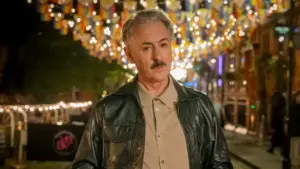
At the centre of it are Niall and Ruben, teenage stepbrothers bound together by trauma, need and a kind of emotional violence neither of them knows how to escape. Niall, played as a teenager by Mitchell Robertson and as an adult by Jamie Bell, is quiet, bullied and closeted. Ruben, played first by Stuart Campbell and later by Gadd himself, is volatile, charismatic and dangerous.
They have plenty in common, none of it good. Ruben’s father is an absent, abusive alcoholic. Niall’s father is dead. Their mothers, Maura and Lori, played by Marianna McIvor and Neve McIntosh, are in a relationship, though neither is exactly a model of maternal care.
When Maura and Lori announce that Ruben is moving in after a stint in juvenile detention – for biting off a boy’s nose, naturally – Niall’s life is cracked wide open. Ruben’s violence soon becomes useful: a shield at school, a source of danger, a model of masculinity Niall both fears and envies. Niall, in return, helps Ruben cheat on a test. And so begins their toxic, can’t-live-with-him, can’t-live-without-him co-dependency.
The show then spends six hours watching that bond curdle.
Every choice Ruben makes seems to lead back to his brutal childhood. Every choice Niall makes seems designed to keep his sexuality buried. Niall’s life bends around Ruben’s needs, rages, breakdowns and explosions. Ruben, meanwhile, feeds off Niall’s adoration. Each wound they inflict – physical, emotional, psychological – only pulls them tighter together.
It is compelling. It is also exhausting.
We all carry some degree of self-loathing, but Half Man asks us to sit with two men whose entire lives appear to be governed by it. They drive themselves, and each other, towards the edge with barely a flicker of hope, redemption or self-awareness. There is no release valve here. No satire. No guilty pleasure. No one to properly root for. Just damage, ricocheting.
The part I struggled with most was Niall’s internalised homophobia. The show offers a few explanations: school bullying, his complicated relationship with his lesbian mother, his fear of Ruben’s judgement. By the end, it is Ruben’s opinion that seems to matter most. But when Niall finally reveals the truth, the moment lands oddly flat. What should feel like a reckoning becomes, almost instantly, about something else.
If you like your antiheroes damaged beyond repair – Fight Club, Breaking Bad, Succession – then Half Man may well be for you. But unlike those shows, there is very little pleasure in the darkness. Succession had satire. Breaking Bad had the thrill of a man breaking bad in real time. Fight Club had swagger. Half Man has a clenched jaw, a bloodied nose and six hours of emotional suffocation.
That is not to say it is not worth watching. Some of the dialogue is stunning. The performances are ferocious. And the central relationship has a horrible, magnetic pull. But six episodes feels generous, with episodes four and five in particular starting to sag.
Still, Half Man is hard to dismiss. It is brutal, ambitious and often brilliant – even when it is almost impossible to enjoy. Just keep the gin nearby. Or Kylie. Preferably both.
HACKS – ★★★★★
(Stan)
All good things must come to an end.
If you’ve been a Hacks fan from the get-go, you’ll undoubtedly know that the final episode aired the other night. And what a finale it was: a beautiful, funny, emotional end to a beautiful, funny, emotional platonic love story.
This season wasn’t perfect. Indeed, not every season reached the brilliance of the first. But with two characters this rich, played by two actresses this wonderful, that almost doesn’t matter. It never really mattered. Deborah and Ava took us along for the ride through all the highs and lows, reminding us – especially in the Trump era – of the importance of laughter, generational conversation and platonic love.
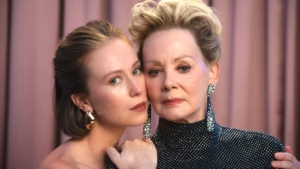
For those of you who have never watched Hacks, the premise is simple enough. Deborah Vance, played by the incredible Jean Smart, is a legendary comedian apparently past her prime. Ava Daniels, played by brilliant newcomer Hannah Einbinder, is a millennial television writer whose career looks as though it may collapse before it has even properly begun. After a backlash-provoking tweet leaves Ava ostracised from the industry, she is forced to work with Deborah in an attempt to revive both their careers.
Ava pushes Deborah, who has cocooned herself in the stale comfort of a Las Vegas residency, to bring more edge, honesty and vulnerability into her act. Deborah, in turn, shows Ava what it takes to achieve and maintain success in an industry shaped by cultural sexism, personal betrayal and ruthless compromise.
Hacks has always been astute about its millennial-versus-boomer culture clash. Across five seasons, Ava and Deborah’s relationship evolved from forced partnership to outright war, and eventually into something like genuine love. Deborah initially sees Ava as a sensitive snowflake; Ava sees Deborah as an out-of-touch sellout. The show began during the Biden era and very much felt of that moment. Much of its humour came from the political-correctness generational gap, with pronouns, DEI, gender and sexual fluidity and even climate change serving both as sources of conflict, humour and as opportunities for mutual understanding.
Over time, both women came to see the world more fully because of the other’s perspective. That feels especially important now. At a time when many of the more inclusive shows associated with the Biden era have either been cancelled, quietly abandoned, or had their sharper edges softened, Hacks stayed the course. Disney, for instance, removed a transgender storyline from Pixar’s Win or Lose, changing the character to cisgender after the part had originally been conceived as trans. Against that backdrop, Hacks continued to explore queer identity, feminism and so-called ‘woke’ politics with aplomb. And it did so without ever becoming polemical or dull. Instead, it remained funny, interesting and, at times, profound.
As I said, Season Five – and indeed the show as a whole – had its patchy moments. But when Hacks soared, it really soared. This season’s standout seventh episode will have you crying tears of laughter, while the finale will have you crying tears of genuine emotion. What carried the show, always, was its consistency of performance, joy and wit.
In these dark times, great acting, real laughter and genuine emotional warmth are not small things. They are more than enough to earn Hacks its five stars.
Reviews by Sean Cook