
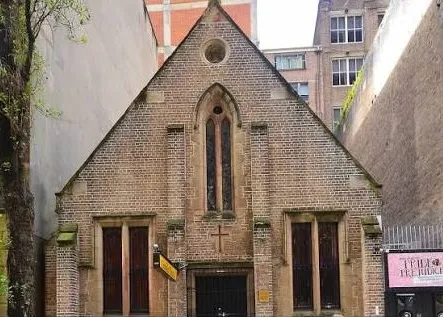



Sydney’s Catholic Archbishop has asked the NSW Government to claw back arts funding from the Divine Playhouse, just as the queer nightlife project prepares for a three-night comeback at the Museum of Contemporary Art.
As reported by the Sydney Morning Herald, Archbishop Anthony Fisher has written an open letter to Arts Minister John Graham calling for the withdrawal of a reported $100,000 Create NSW grant, arguing the venue’s programming mocks the Catholic faith.
The Divine Playhouse, which began life as the Unholy Playhouse, opened in July inside a 158-year-old deconsecrated church in Sydney. Its run was short-lived. After Christian groups protested on opening night, the venue was forced to shut its doors and cancel all events. Critics took issue with programming that played on Catholic imagery, including a “live exorcism” and a “Sunday mess”, while some opening-night guests turned up dressed as nuns and choir members.
Now the project is back. The MCA has announced UNHOLY/DIVINE, a three-night celebration in October bringing together more than 50 artists. The program opens with an “Unholy Funeral” to farewell the Divine Playhouse, followed by a night of awakening, and closes with an evening inviting guests to confess their sins and indulge in what organisers promise will be “very naughty art”.
That return has reignited the Archbishop’s objections. In his letter, Fisher acknowledged the right to artistic freedom but said the Church was “deeply concerned that the government is financially supporting productions that mock, degrade or deliberately provoke the Catholic community”, the Herald reported.
He singled out the event’s promotional material, which features three inverted crosses and references to adoration, confession, hymns and processions. According to the Herald, Fisher described this as “the deliberate appropriation and, in our view, sexualisation and denigration” of sacred Catholic symbols, adding that the government “cannot credibly call for religious tolerance and social cohesion, while quietly funding intolerance and division”.
Minister Graham, however, says the money can’t be returned: it was spent fitting out the original venue before the group was evicted by developers Revelop, co-founded by billionaire cousins Anthony El-Hazouri and Charbel Hazzouri.
He also made clear the government has no intention of policing what appears on stage. “I don’t really support people mocking each other, but the idea that government is going to say yes and no to who’s performing on stage is not a principle that we accept,” Graham said, as reported by the Herald.
The issue has since reached NSW Parliament, where Liberal MP Susan Carter asked how much public money was going towards what she called a “disrespectful depiction of the Christian faith”. Graham responded that the government supports the MCA through both Create NSW and Placemaking, and had already funded the original Divine Playhouse.
Greens MP Cate Faehrmann came out in the event’s defence, pointing to the government’s long history of supporting Mardi Gras and to the harm the Church has done to queer people. “Under the Catholic faith, the LGBTQIA+ community has been discriminated against, persecuted and traumatised. For a lot of people, this is their way to celebrate where they are now,” she said, according to the Herald.
She added that a bit of irreverence was no cause for alarm, telling Parliament that a little “thumbing of the nose to faith” was fine and encouraging everyone to go along.
For organiser Kat Dopper, founder of Heaps Gay, the backlash has been deeply personal. She has previously said she received constant death threats and homophobic messages after the venue opened, and that she changed its name from “Unholy” to “Divine” just 12 hours before opening in an effort to avoid causing offence. At the time, she said she had offered to remove the elements Christian groups objected to, despite not believing they were offensive, simply to keep the space open.
It didn’t work. Revelop evicted Dopper under an obscure “offensive trade” law typically used to regulate foul smells and industrial waste. Both sides have said they will fight the eviction in court.