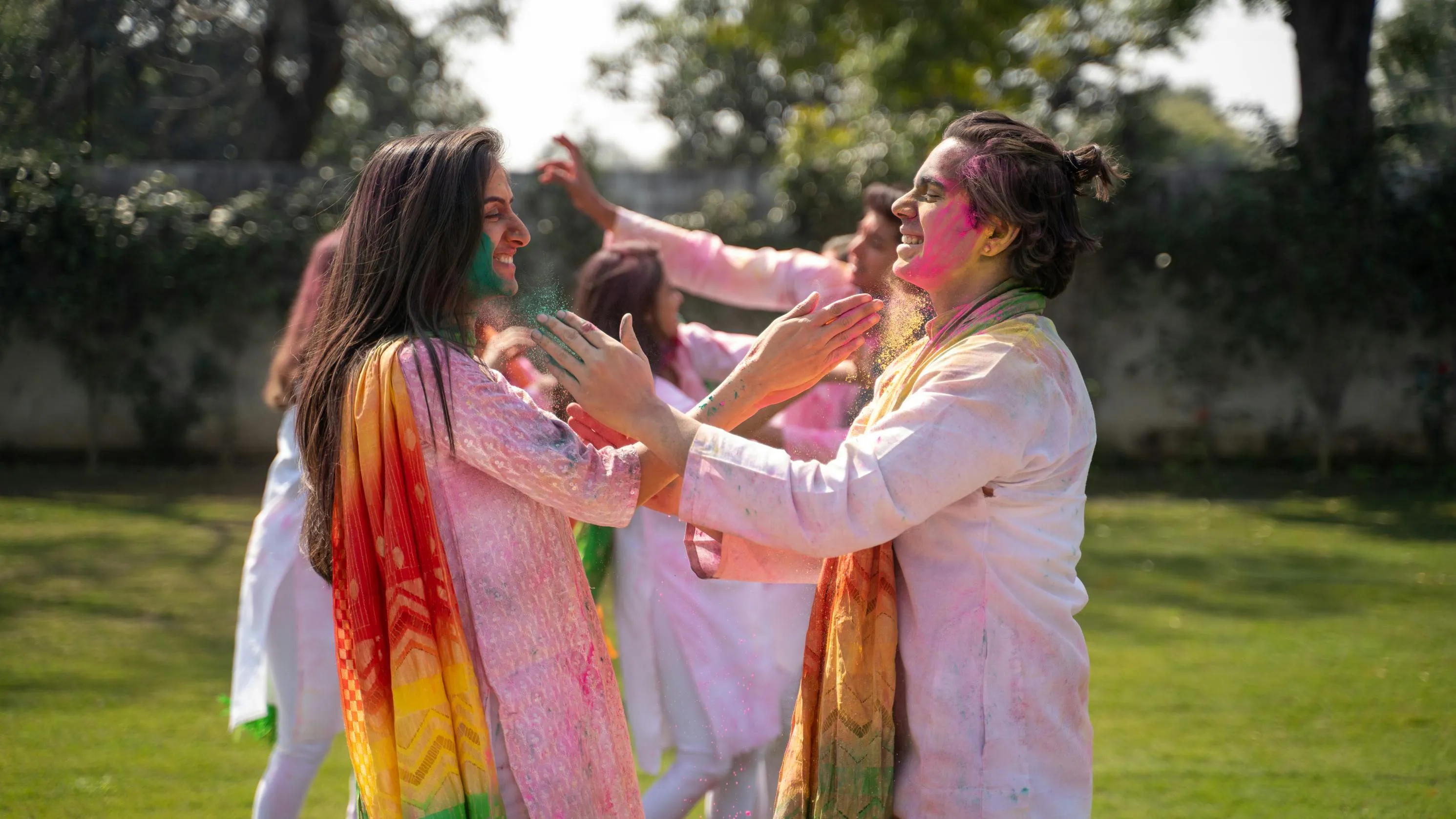



The Australian Capital Territory (ACT) is home to one of Australia’s largest migrant populations and boasts the highest percentage by total population of LGBTIQA+ residents in the country. Yet, the multi-coloured rainbow contrasts sharply against ACT’s achromatically white LGBTIQA+ representation, writes Sean Perera.
The Australian Bureau of Statistics (ABS) 2021 Census reported that 28.7% of ACT residents were born overseas. This differentiates the ACT by merely 5.8% from NSW, which has the highest migrant population in Australia.
The ACT also has one of the highest proportions of LGBTIQA+ people in Australia (~5.9%), which is 1.4% higher than the national average (4.5%).
Therefore, it would be reasonable to expect greater multicultural diversity across the ACT’s LGBTIQA+ spaces. Sadly, however, the territory’s statistically multicultural pride flag, resembles in reality a closet, that is unimaginatively white-veneered, like the ones available from a certain Swedish store in Majura. There is little-to-no visibility of people of colour in the ACT’s LGBTIQA+ discourses.
Among the 14 members of the ACT LGBTIQA+ Ministerial Advisory Council, only one name identifies with a culturally and linguistically diverse background. Inquires to the Advisory Council for greater multicultural representation, were believed better directed to Multicultural ACT. Both government entities transfer responsibility akin to a reenactment of the biblical Pontius Pilate and Herod Antipas scenario.
A more publicly visible space, A Loving City: Queerberra Revisited photographic exhibition at Canberra Museum and Gallery, was no different. The 2017’s marriage equality affirmation portraits on show were as colourful as a rainbow in the midst of a cloudless Canberra drought. Any hope for non-whiteness only hung around the margins behind Queerberra’s projector screen.
However, representation of LGBTIQA+ Canberrans from multicultural backgrounds, in particular people of colour from the Global South, is not statistically unfeasible in the ACT. While the territory’s census data does not aggregate residents’ ancestries, available ABS data indicate that approximately ~18.75% ACT residents belong to ancestries from South Asia (~6% to 10%), East Asia (~6% to 9%), Africa (~1% to 3%), and Latin America (~0.5% to 2%). This is almost a fifth of the ACT population. Conservatively based on the national average, it is therefore possible to estimate that around 4,000 Canberrans of Global South ancestry would identify as LGBTIQA+. Yet they remain marginalised, or even worse invisibilised, in the territory’s LGBTIQA+ discourses, which are exclusively Eurocentric and white.
It is not the objective of this piece to try and educate anyone that gender is culturally constructed. Even LGBTIQA+ labels do not translate nor transfer seamlessly across languages and cultures. Moreover, non-binary gender communication is fraught with contending ideologies to conform to heteronormative narratives, even in enlightened Canberra.
The situation is more egregious for LGBTIQA+ Canberrans from conservative migrant communities that strive to preserve traditionally handed-down binary ideologies, like an ill-fitting pair of stilettoes with one wobbly heel. Thus, the ACT’s whitewashed LGBTIQA+ spaces, which demand conformity to colourlessness from LGBTIQA+ Canberrans of colour, render further marginalisation to those who are already marginalised. This may explain the dearth of multicultural representation in ACT’s LGBTIQA+ spaces: because those spaces were never created for colour.
This piece is an appeal to extend the ACT’s multiculturism beyond that of the post-colonial narrative of the National Multicultural Festival food stalls and stage dances. The ACT needs to truly embrace and dive deep to understand what it means to be culturally and linguistically coloured and queer in predominantly straight, white Canberra. The ACT ministerial portfolios with oversight over Multicultural ACT and the Office of LGBTIQA+ Affairs need to act jointly to address the deficiency in the intersection of their respective portfolios.
For neither is racist homophobia nor homophobic racism a good thing.
Sean Perera is an academic, an author and experiential philosopher. He holds a PhD in science communication and currently lectures on cross-cultural communication at The Australian National University in Canberra. Read the review of his queer novel, a Butterfly, here.