Avatar: Forms of Vishnu
Review by Sean Perera
There is always something slightly uncomfortable about encountering aspects of one’s cultural inheritance through the institutional gaze of a Western art gallery. So, I arrived with some scepticism at the Art Gallery of New South Wales to view the exhibition, Avatar: Forms of Vishnu.
As someone of South Asian heritage, and familiar with Indian culture and mythology, I wondered what a major Australian exhibition about Vishnu and his avatars could tell me that I did not already know. Would the complexity be reduced to a collection of exotic images and familiar stories? Or worse, would the mythology be over-explained? I found myself unexpectedly absorbed.
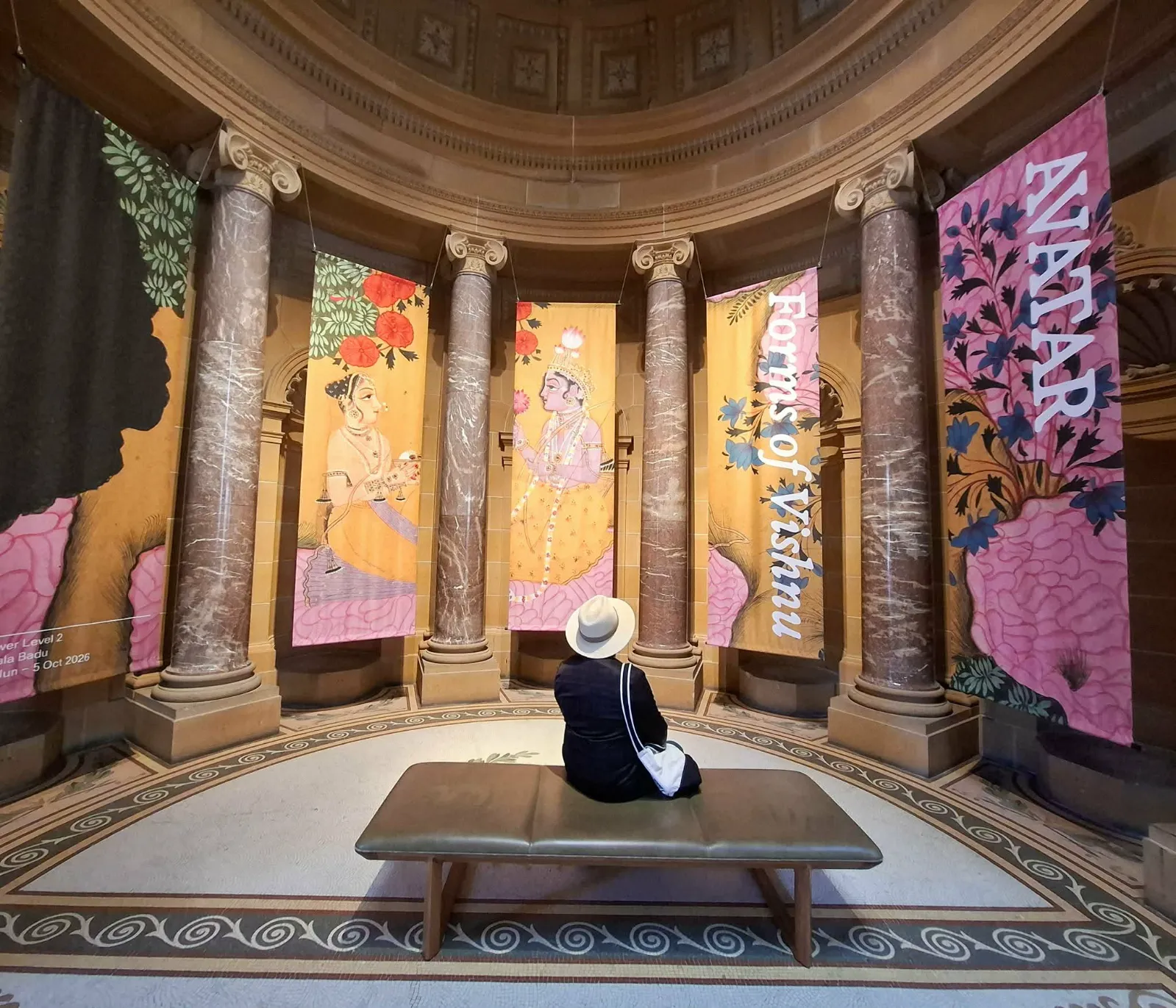
What struck me most was the restraint of the curatorship. The exhibition provides enough context to understand the narratives, symbolism and relationships between Vishnu’s manifestations (i.e. Avatars), while leaving room for something increasingly rare in contemporary exhibition-making: silence. Space to simply look. Space to wonder. Space to bring one’s own knowledge and experience to the encounter.
Avatar traces Vishnu’s many manifestations through fifteen centuries of art and storytelling from South and Southeast Asia, bringing together sculpture, painting, textiles, photography and contemporary works. The exhibition moves through the familiar Avatars — including Matsya, Kurma, Vaamana, Rama, Krishna, and the future avatar Kalki — while placing them within a much broader artistic and philosophical landscape.
Familiarity, it turns out, can sometimes be an obstacle to seeing. Occasionally, it takes a carefully curated exhibition to make us look again. For me, this was where the exhibition became particularly compelling. I recognised many of the stories and images, but seeing them assembled within the exhibition’s larger conceptual framework made the familiar feel unfamiliar again. I began noticing relationships between the Avatars, their stories and their representations that I had not previously considered.
The word Avatar itself offers an important clue. Derived from the Sanskrit avatāra, it refers to a descent — Vishnu taking different forms to restore balance when cosmic order is threatened. But the idea of taking form is also what makes the exhibition so intellectually intriguing. What does it mean for one divine presence to manifest through multiple bodies, identities and possibilities?
The exhibition does not provide a single answer. Nor should it. And perhaps this is where Avatar unexpectedly resonated with me as a queer viewer. Not because the exhibition attempts to make Vishnu or Hindu mythology “queer” — it doesn’t — but because the very concept of the Avatar challenges the assumption that identity must have a single, fixed form.
Vishnu’s identity is not diminished by multiplicity. Transformation is not a departure from essence; transformation is part of the essence, while questioning, reinterpreting and reflecting what it means to be Vishnu.
From a queer perspective, particularly one which seems to sit uneasily alongside contemporary understandings of identity, there can be something quietly powerful in encountering a tradition in which transformation, multiplicity and changing form are not necessarily contradictions. They can be ways of expressing continuity. And that may be the exhibition’s greatest achievement!
The exhibition systematically introduces us to Vishnu’s Avatars, but ultimately resists reducing Vishnu to an explanation. Something remains unknowable, open-ended — an invitation to contemplation rather than a conclusion.
I entered expecting to be told something I already knew. Instead, I was given the opportunity to reconsider what I thought I knew. I left thinking less about the individual avatars than about Vishnu as an idea: preservation and disruption, order and chaos, embodiment and transformation, singularity and multiplicity. Perhaps that is what a good exhibition should do. It should not simply give us more information about something we did not know. Sometimes, it should make us question what we thought we already understood.
Avatar: Forms of Vishnu continues at the Art Gallery of NSW until October 5. Click here for details.