For decades, Sydney has been the home of Australia’s largest queer community. Of course, this has been spurred on by the annual Mardi Gras, one of the largest LGBTQIA+ celebrations in the world, but the other element of that is Oxford Street itself.
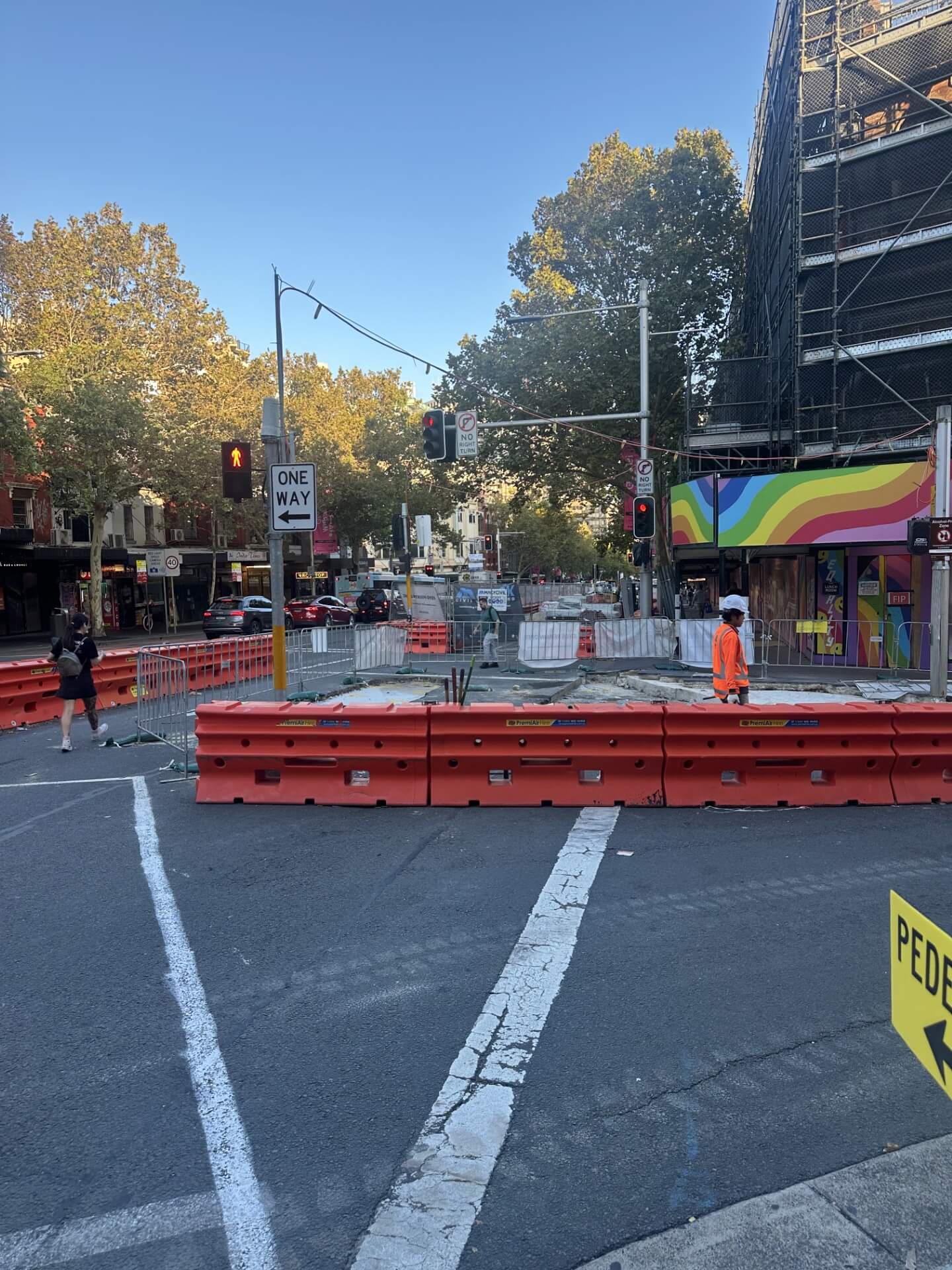
Right now, though, the street looks less like a glittering welcome mat and more like a building site. Years of hoardings and scaffolding from the delayed Oxford & Foley redevelopment, as well as the delayed cycle lane, has left whole blocks to fall silent. The $200-million project promised heritage façades, laneways, shops and creative spaces. It was meant to open in time for WorldPride in 2023 but now in late 2025, it’s only just starting to welcome its first tenants.
The redevelopment isn’t the only thing that’s changed the landscape. Heaven and Nevermind both collapsed. Stonewall reduced trade and even the ever-popular Green Park Hotel closed its doors in 2020.
This year, it felt like the strip lost one of its last surviving icons, ARQ. For the last 26 years, you knew you could always end up there and have a good time. You could see drag queens performing and meet your best friends in the infamous Trash Alley. But ARQ closed its doors earlier this year and reopened as Aura under new management who promised to stay connected to the queer community. Co-owner Dave Auld told Gay Sydney News that he was keeping Friday nights open to queer promoters. However, few have taken up the offer.
The new owners also run Noir, a club that’s one of a few new straight clubs on the strip; a jarring presence in what was once the undisputed gaybourhood. Situated right next to the legendary Stonewall, Noir has been criticised in the past for its aggressive and homophobic clientele with renowned drag performer Kevin Kalia taking to Instagram after being assaulted walking past the venue. The owners did their damage control but for many in the community it was a sign of the strip changing.
Some welcome it: more venues, more late-night licenses, more life on a strip that had gone quiet. But others see it as a creeping cultural shift. What it now means for visitors is that you might rock up for a gay Sydney weekend and find yourself surrounded not by fellow queers, but by hens’ parties.
The worry is that the queer soul of the strip gets written out of its own story. A strip that looks good in a brochure but doesn’t serve the community who fought to make it matter in the first place. For any gay Australians who’ve long seen Oxford Street as a spiritual home, it’s bittersweet. You want to believe in the revival but it seems to never come.
There are sparks, though, with newer queer parties thriving. The latest one to capture the night is Flash. Initially hosted on Oxford Street, after two sold-out months there it moved to a bigger venue in Kings Cross. One of its three founders, Rojdar believes that ultimately the area will be stronger.
“Now more than ever, the community needs more safe spaces and places to connect with the community. The scene is evolving and it’s great,” he said.
Being part of the queer community is beneficial for people, says Rojdar. However: “Unless the venues and festivals become owned by the community, it’s a matter of time until we lose even more spaces to straight promoters and their weird obsession with selling booths.”
Beyond gay clubbing, a broad acceptance of drag can be seen throughout Sydney. The Imperial Hotel in Erskineville has long been waving the queer baton and it’s far from the only place in the inner west to do so. Many straight pubs across town can be seen hosting weekly drag shows and drag bingo and trivia are also regular fixtures. There is an argument to be made that broader acceptance means less of a need for specific queer venues but that’s far from a universally accepted sentiment.
Oxford Street used to be the place that everyone in the rainbow community would feel at home. While the strip isn’t exactly dead, it is at a crossroads. If it’s to remain the queer heart of Sydney, for locals and visitors alike, then it needs more than shiny façades. It needs to keep making space for the messy, the political, the diverse, the young, the broke, the fabulous, the out-of-towners.
It remains a crucial place for our community and when it shifts, it ripples outwards and shapes what queer life looks like everywhere.
The question isn’t whether Oxford Street will survive, it will. The question is: will it still feel like home?