REVIEW:
LUKE
Red Stitch Actors’ Theatre
By Angus Cameron
Directed by Iain Sinclair
Performed by Olga Makeeva, Dion Mills and Will Lonsdale
Review by Christos Linou
4 out of 5 stars
LUKE is an impactful play that centres on a discussion between a teacher and student, witnessed by a friend/mother figure, which explodes into a maelstrom of sexual innuendo, secrets, lies, imaginary truths, and the misgivings of education, trust, friendship and gay love.
The play opens with a lounge room scene and defines the mistruths about recollecting memory. The year is 2007: the panels are ornamented with curios, books, a kitsch mini bar cluttered with wine and whisky bottles and a retro LP turntable that captures a cosy and private space for conversations and merriment. Yet all is not well in the house of Country Victoria, where gossip spreads fast, especially if a teacher in a local school wears a dress and dances in the dark with young boys.
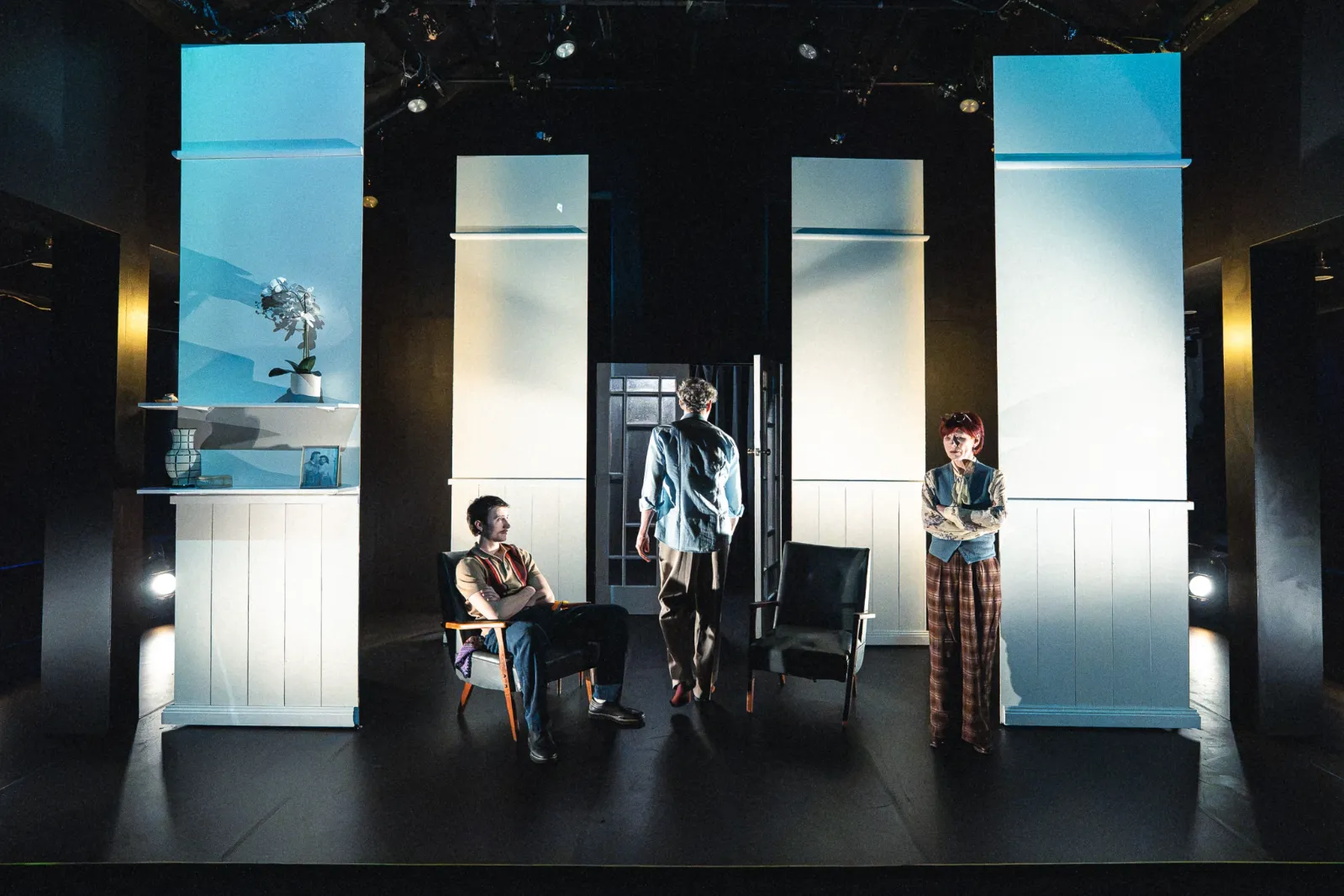
The set design consists of four large floor-to-ceiling panels that acted as rotating walls and were rotated by the performers during the play to indicate different scenes and locations in time. The triangular walls are a cleaver devise and are turned at precise moments during the play, keeping the audience engaged during the 90 minute performance.
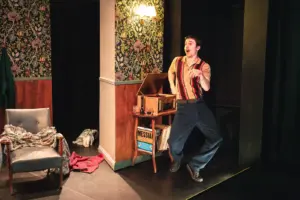
The premise is about a young student called Chris (played by William Lonsdale), who we hear recollecting memories to Olena (played by Olga Makeeva) about his teacher, Damon (played by Dion Mills). Supposedly, the teacher was watching the student during a school team rowing exercise. Chris, the last student to leave the boathouse shed, is aware his teacher was watching him; Chris was changing out off his clothes and stood naked. The teacher stares at the naked student. Nothing takes place other than the admiration of a youthful male body; and a young gay boy, who was not sure of his sexuality and is seeking attention from a mature-aged man. This becomes the catharsis for the plot, as Chris suggests a betrayal of authority with an act of grooming by his teacher. As the play unravels, the misgivings are based on a possible innuendo and flirtation with homosexuality that a teacher and student are deemed not to cross, to discuss, or to act upon. Yet there is tension as Chris confesses his attraction to men and love for his teacher in an ode to the film To Sir with Love. As the play develops, he insists he was watched by his teacher as an act of predatory lust.
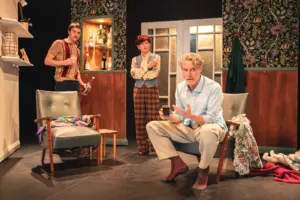
The actors are engaging and convinced that they are being attacked from all sides by political and social opinions regarding the intimacy in education. Dion Mills as Damon is a standout performer and creates an array of chameleon-like twists of emotional sentiments that you feel compassionate for his attempt to realise that education can be beautiful and loving if the relationships between teacher and student can be truly discussed.
A waltz between teacher and student reveals their awkward attraction while taboos about love for younger men are seamlessly delivered by the artistry of Mills acting skills, hoping that his knowledgeable qualities will attract the love of his student. He cites: “I put it to you that there is an eroticism in education.” Teasing and taunting about gay love and homophobia are exposed and the scene shifts where the music of trumpeting gay revolution is subdued with a drone of dark despair. The teacher, in a trance, rotates the walls and transforms the cosy loungeroom panels into a bleached, whitewashed space.
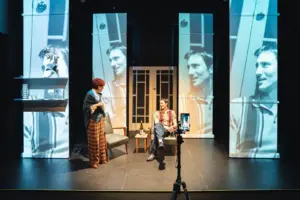
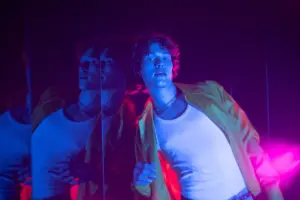
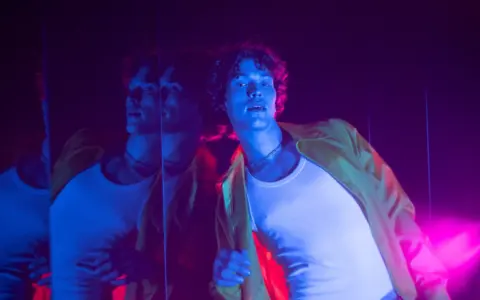
The play shifts and Chris reveals his true intentions to Olena. Chris is projected onto the panels that become a surveillance of the characters’ lies and truths. It was an effective cross-art form device,as the close-up of Chris’s face was projected as multiple black-and-white profile and portrait shots onto the three panels, acting as Chris’s confessional prison.
The title of the play is LUKE, which is the title of the book that Chris has written about himself. He has returned to his hometown in 2017 to triumph and boast about his success in writing a best-selling book. He gloats that it will be produced into a movie, and he is searching for more homophobic scandals about his teacher as he sensationalises the truth about the past and fills the gaps with his imaginary lies. Olena listens but is abashed with pain and hurt from Chris’s intentions; he is falsifying the truth and the facts through his imaginary erotic feelings for an older man. The book causes country gossip, shattering the teacher’s reputation and Damon’s life is ruined by sexual shame.
Olena walks away slowly in a state of bereavement for the loss of trust in humanity. As she witnesses the hurt of gay shaming, she moves to the panels and deconstructs the space: the whitewashed walls are rotated to black and the empty backside of the triangular shape. Olena draws all the curtains to reveal the underbelly of the space as a metaphor for the bleak, dark underbelly of the antagonist, Chris. Her portrayal of love and loss captures the attention of Chris’s selfish lies about past events, using the stigmatisation of homophobia onto his teacher as a form of the premise for writing his book.
The walls are rotated for the final time, transporting back to 2007. The loungeroom scene is exposed as bookends to the play, establishing the comfort zone of memory and reestablishing the friendships of Olena and Damon and the young student Chris, where teacher and student discuss the philosophical opinions of queer love in life and education. Olena gracefully performs her role as the redeeming Mother figure in the play to reveal the ugliness in Chris’s lies and his selfish behaviour, where he has little regard for the hurt and pain that innuendo and gossip will cause.
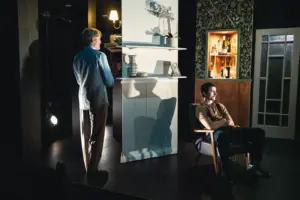
Are the young at heart at the mercy of learning, which is mastered by the sadistic trickery of a pompous, knowledgeable teacher? Or is the desire and lure of lust played out by a cruel, conniving student? The ensemble is a dynamic cast of performers who act out memories from the past about non-consensual intimacy. The actors all played their part in deceit and betrayal, where trust is unhinged, leading to the dark side of one’s morality.
Playwright Angus Cameron has crafted a lyrically dark examination of what may have taken place in the class of 2007 and jumps forward to 2017, with the conversations about Australian politics as a form of debate to challenge the changes in social opinions about homophobia and the age of consent. Cameron has developed a riveting examination of how memory can become blurred using a tactical shamming of the other. He writes in the program:
“Luke was inspired by the entanglement of memory, identity, trauma, and storytelling. It’s an ode to the magic of mentors and the consequences of silence. When we try to remember, to tell a story, we begin to lie, to ourselves and to others. We omit, we reframe – we fall short of what is and what was.”
The director, Iain Sinclair, has collaborated with extremely talented actors and at times their stage presence is larger than life. Sinclair has composed a riveting tempo so that the actors don’t get caught up in speeding through the script; they embody the words and are absorbed by the plot. The strength of a director is alerting the internal space of an actor where the nuances of love and hate are felt, rather than said.
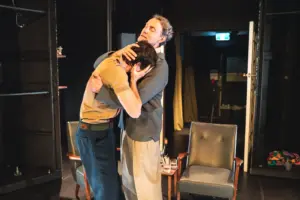
Sinclair has softened the urgency of the script and the actors are pushed to their ability as narrators of words and into an embodiment of actions. Pent-up and bottled emotions explode with grievances of narcissistic sexual bravado and the innuendo of gay erotica used as a form of media exploitation, regardless of consent. Through Sinclair’s direction, a debate is created through the darkness of irony, humour and comic relief. Cameron’s script is lyrically creative and tiptoes through a broad brushstroke of homosexuality from the Ancient Greeks, encouraging teacher/student relationships of love and knowledge to the current social taboos that discuss the sexual predatory elements in educational institutions.
I was engrossed in the play and I heard similar gasps from the audience who could read between the lines of the antagonist. I felt like calling out, “Chris is a fucking liar!”
Red Stitch has produced LUKE through their INK Development Program, where playwrights, directors, actors and production teams collaborate to encourage and support the development of risk-taking theatre. The season of LUKE continues until 11 October at Red Stitch Theatre space in St Kilda East. For further information, go to https://www.redstitch.net/