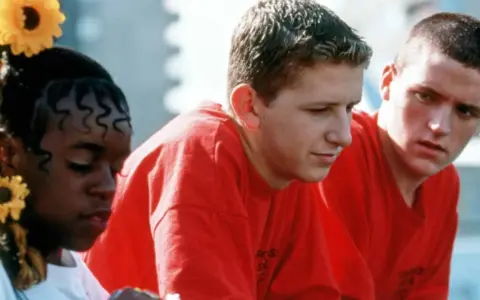
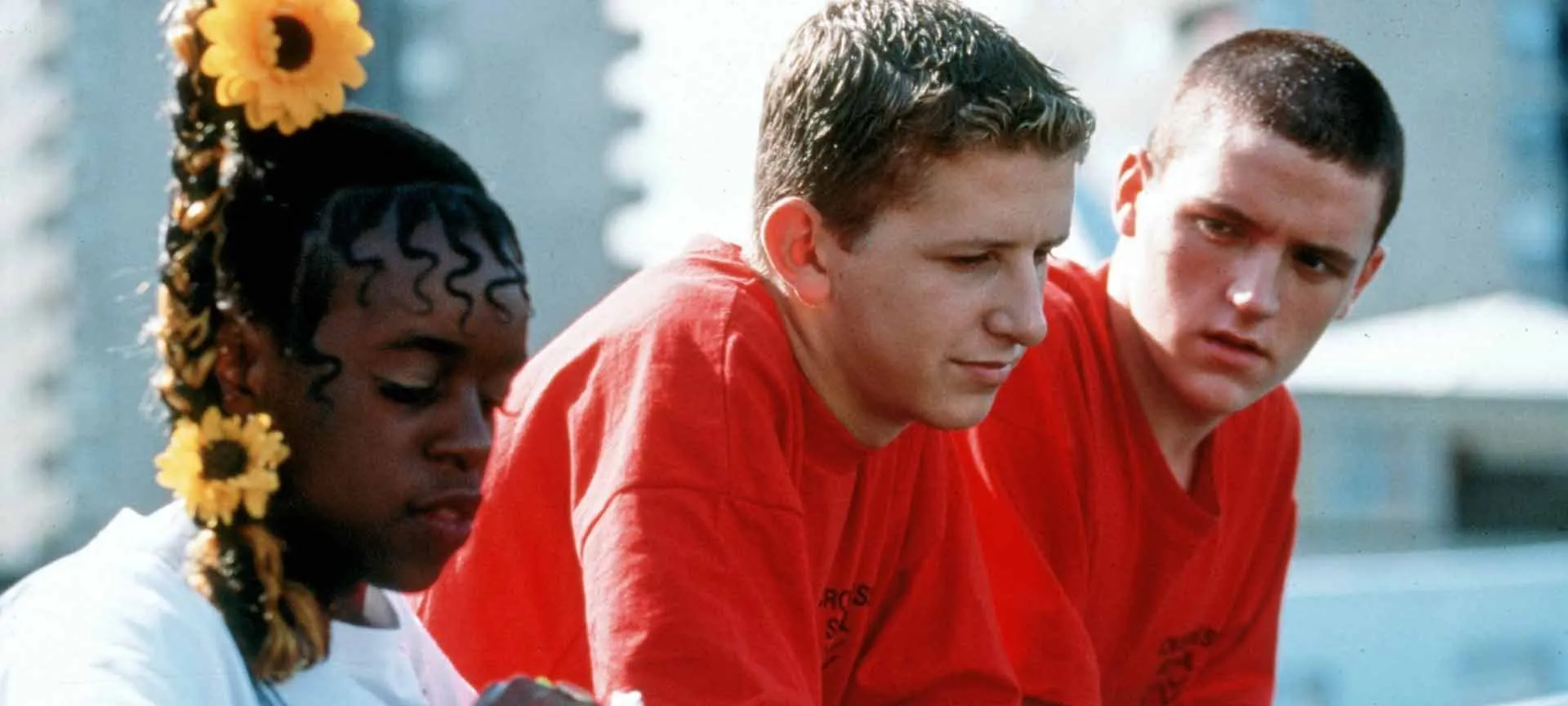

Jonathan Harvey’s Beautiful Thing turns 30 this year. Adapted from his hit stage play, the 1996 film told a rare story at the time: a joyful coming-out romance between two working-class teenage boys on a London council estate. In an era shaped by HIV/AIDS, Section 28 and a relentlessly hostile tabloid press, Beautiful Thing offered something radical – tenderness, hope and the possibility of happiness. It also quietly captured the overlap of class, race and queerness in Britain well before “intersectionality” entered common use, writes Sean Cook.
I was 16 and living in Melbourne when I first saw Beautiful Thing. I was out to only a few friends, still carrying a lot of shame, frightened by the spectre of AIDS and with no queer role models to show me a future. Like Jamie, I came from a working-class family, lived with a single mother and was in love with my best friend at school. Beautiful Thing was the first work that made me feel those things were not just survivable, but beautiful. I spoke to Jonathan over Zoom from his home in Liverpool about the play, the film and its enduring afterlife.
Sean Cook: Beautiful Thing premiered at the Bush in 1993, and the film followed less than three years later. How did it happen so fast?
Jonathan Harvey: Before the play opened, Film4 had already read it and liked it. They asked if I’d be interested in doing a short film. I said no – I’d never even seen a short film, it sounded really boring. Then the play premiered, it ran for six weeks, and that summer they called me back and said we want to make it into a feature. I hadn’t gone looking for it. At that point my ambition was to write for the Liverpool soap opera, Brookside. That was the height of where I thought I could get to. So to suddenly be doing a feature film was really weird.
SC: How did the producer and director come on board?
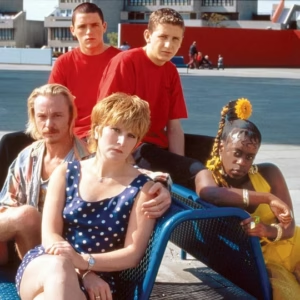
JH: Film4 said go and meet some producers, see who you want to work with. I remember going around various really posh producers and having meetings with them. At the same time I was developing a sitcom about my teaching days with a producer called Tony Garnett – he’d produced Kes and Cathy Come Home. Tony said something really pertinent to me. I was meeting all these posh producers and they were throwing star names at me to play Sandra – Julie Walters, people like that. I would have killed to work with Julie Walters. But Tony said, be careful – Beautiful Thing will live or die on its performances, and the minute you put a famous face in it, the audience will stop believing something in it. Even though it went against every star-fucker instinct I had, I knew he had a point. Then he said he’d love to throw his hat into the ring, and it was a no-brainer. He was working class, I liked what he stood for. Then he said, I found the director for you, Hettie McDonald. Hettie had directed the play. But she’d never been behind the camera before. I was a bit fucked off. I thought, we’re two novices together. We’re gonna mess this up. I felt I needed someone with loads of experience to hold my hand through the process. Tony said he he would surround us with all the experience we needed. He said, Hettie’s the best choice because she understands the story so well. She had directed it at the Bush, and then in the West End. So he was right. It was weird, it all just fell into my lap.
How did you find the process of adapting the play into a film?
Really hard. I knew what theatre looked like in my head, I even knew what television looked like. I had no idea what the difference was between TV and feature films. The notes on the early drafts were: this is like a very long episode of Grange Hill where two kids come out. And they were absolutely right. I had loads of scenes set in the school. Hettie was really good. She said, the play works because it’s claustrophobic – why don’t we keep the film on the estate wherever possible, and only leave when we really need to? That was really good advice.
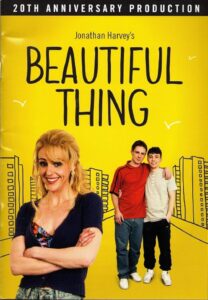
Am I right in thinking you came to Melbourne with the film? I’ve got this vague memory of my 16 year old self going to see the film and you were there and gave a speech.
Haha, yes. Look at you. I was teaching in Thamesmead – quite a rough area, very few British teachers would go there, so there were loads of antipodean teachers and they were all my mates. So when they offered me festivals, I thought I could go to Australia and see my friends. I was absolutely skint though. The per diems were rubbish, so I lived off the canapés at every event the festival sent me to.
The film went to Cannes too, didn’t it?
Yeah. Film4 weren’t going to pay for us. So the cast and I paid our own way. I remember walking the red carpet with the cast, fireworks going off, wearing a free Paul Smith suit, and thinking: this must be what my career is going to be like forever. I also remember going on stage at Pride in London, and for the first time I understood what it felt like to be a rock star, not that I want to be a rock star or live my life like that, but we went out on stage and looked out onto this sea of people cheering for us. It was lovely to be given the opportunity to taste it for a bit.
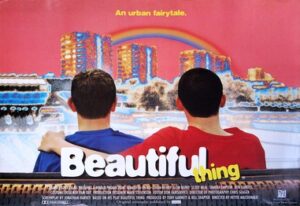
The film offered such a joyful counter-narrative to the way Black, queer and working-class lives were represented in the mainstream press at the time. Was that intentional?
Absolutely. I wrote the play in 1992 and the debate was raging in Parliament about the age of consent – 21 for gay men, 16 for heterosexuals. I was sick of it. The discussion was always about buggery and sodomy, a load of posh Tory men giving their take on homosexuality. I wanted to challenge the preconception that that’s what being gay was about. There was also this narrative that if you were working class and your family found out you were gay, you’d be kicked out and end up a rent boy. I wanted to challenge all of that. At the same time Beverly Hills 90210 was the popular teen drama, and there were loads of examples of where the geeky girl would go to the prom with the jock, who was the captain of the soccer team. I wanted that fantasy, but with two guys. Looking back it feels very sweet. But at the time it was actually breaking the law – the boys were underage. At certain screenings people would gasp when the boys kissed. It’s hard to imagine that now. So yes, it was political with a small ‘p’.
Have you ever been tempted to write Beautiful Thing 2?
It’s crossed my mind. But the relationship, in my head, was never going to last forever. It’s about first love, those first flushes of feeling. I don’t want to disappoint people and say, well, they might have broken up. I don’t want to spoil the memory of the original.
It’s now part of the queer canon. Was there anything queer that inspired you growing up?
The thing that made me want to write was Letter to Brezhnev – set in Liverpool where I grew up, written and directed by queer filmmakers. But there wasn’t much overtly gay work around back then. My big inspirations were Mike Leigh and Victoria Wood. My early writing felt like the bastard love child of the two. Alan Bennett was a big hero as well – obviously gay, but he never wrote massively gay stuff. There just wasn’t that much around. Actually, a mate dragged me to see Angels in America at the National Theatre in around ’93, ’94. Up until then I’d been terrified of HIV, scared of any discussion about it. I didn’t know anything about the play going in. And I just thought it was absolutely magical – the direction, the acting, the writing, so visceral. I knew then that I had to face up to my fears. It sounds wanky, but it did change my life. From then on I understood that theatre had the ability to be life-changing.
How do you feel about Beautiful Thing now?
I’m really proud of it. I’ve got loads of little children – all the plays, all the other stuff I’ve done. But I’m really proud of this one. It’s done well for itself. The film keeps getting shown and the play keeps getting produced all over the world. It’s amazing.