
When the Sydney Gay and Lesbian Mardi Gras hit the Sydney Cricket Ground in 2022, it felt more like a holding pattern than a reunion. The stadium was full, but many were already thinking ahead to WorldPride 2023. That year’s SCG parade offered a Mardi Gras the street could not: stadium performances, clear views for everyone and floats navigating the pitch, waving to friends and supporters. Pride was present but protest was not. The street energy, unpredictability and sense of queerness disrupting the city were replaced by seating plans and security checkpoints. Behind the scenes, Mardi Gras was quietly under strain. International tourism was limited, production costs were rising and the organisation was absorbing financial pressures that would only later become public, writes Eliot Hastie.
2023: WorldPride on Oxford Street
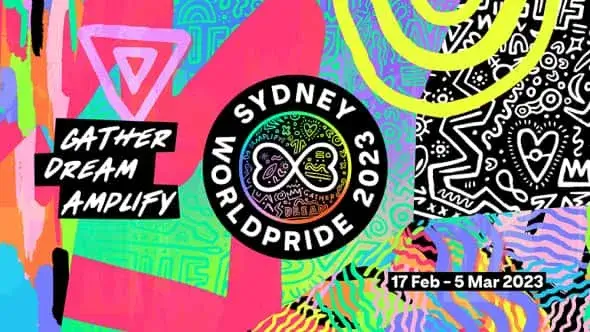
After two years of pandemic disruption, Mardi Gras returned to Oxford Street in 2023 as part of Sydney WorldPride, attracting tens of thousands of local and international visitors. It was the first WorldPride in the Southern Hemisphere and the city was painted rainbow with over 45 installations, many of which remain today, including the Coogee Beach rainbow and the Progress Shark, which lives on through a popular Instagram page. The parade brought the festival back to its historic route, even as scaffolding and construction hoardings reminded attendees that Oxford Street was still in mid-redevelopment.
Sydney embraced its queer community more than it ever has before, or since, and everyone organising it wanted to leave a mark. Musicians like Kylie Minogue, Kim Petras and Kelly Rowland gave it their all, while Nicole Schrengizer made us wet at the first ever Bondi Beach Party. Across the 17 day festival, it was all about the spectacle of Mardi Gras. It was also the last Mardi Gras for CEO Albert Kruger, who led the organisation through the pandemic.
While the scale was impressive, WorldPride also highlighted existing tensions. Corporate sponsorship and visible police presence prompted debate about the balance between celebration and protest. Activists reminded attendees that Mardi Gras began as resistance, not spectacle. At the AGM that year, Pride in Protest gained a board seat, and members voted to end the police accord, which had allowed officers to conduct public decency inspections, a change implemented in 2024. For the first time, members also voted on a motion for Mardi Gras to support the Boycott, Divestment and Sanctions (BDS) movement for Palestine, foreshadowing recurring debates in coming years.
2024: Our Future
If 2023 was about spectacle, 2024 was about disruption. CEO Gil Beckwith took the helm and days before the festival launch, Fair Day at Victoria Park was cancelled due to asbestos-contaminated mulch. The cancellation removed key revenue streams, contributing to a record $1.24 million deficit, later addressed by a rescue package from the NSW Government and City of Sydney. Internal reviews later found budgeting processes had failed to keep pace with changing conditions, leaving the board without an accurate financial picture until the crisis arrived. For many, it was a symbolic moment: a festival under pressure, fighting to protect spaces that once felt reliably ours.
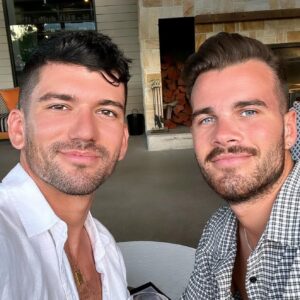
Mourning and Mobilisation: Jesse Baird and Luke Davies
Amid these financial and logistical shocks, the LGBTQIA+ community endured a profound personal loss. In early 2024, the alleged murders of Jesse Baird and his partner Luke Davies by a serving NSW Police officer shocked the community. Activist groups, particularly Pride in Protest, called for police exclusion from the parade, especially in uniform. Mardi Gras initially banned uniformed officers but the decision was later reversed: police marched out of uniform, though many wore emblems and the Police Commissioner marched surrounded by armed officers. From that moment, police participation ceased being symbolic and became a defining fault line in Mardi Gras politics.
2025: Free to Be
In 2025, Mardi Gras adopted the theme ‘Free to Be’, even as some sponsors, including AMEX, withdrew amid changing global diversity policies. The festival delivered a surplus, helping drive a motion for 100% public funding, reflecting unease with corporate reliance. Police again marched.. and protest followed. The debate had evolved beyond uniforms to a broader question: Whose freedom does Mardi Gras celebrate and at whose expense? Pride in Protest and the newly formed Protect Mardi Gras clashed over this with PIP advocating a return to political roots while Protect Mardi Gras emphasised broad participation.
At the AGM, motions to exclude NSW Police and to support the BDS movement were both narrowly defeated, showing community divisions but also a willingness to revisit controversial issues. 2025 also marked the departure of CEO Gil Beckwith with Jesse Matheson confirmed as CEO ahead of the 50-year anniversary, tasked with uniting these fractured factions.

Still Becoming
Since 2022, Sydney Gay and Lesbian Mardi Gras has been reshaped not only by pandemics and headline spectacles, but by tragedy, disruption and internal reckoning. A stadium parade symbolised distance. An asbestos crisis cancelled a foundational community day. The murders of Jesse Baird and Luke Davies forced the community to confront policing in ways that cannot be undone. Financial pressures continue and the festival’s identity remains contested.
Mardi Gras has always been more than a parade. It began as a protest, it survives as a celebration and today it exists at the intersection of both. The question now is not whether Mardi Gras is political, it always has been; but about whose politics will shape its next chapter.