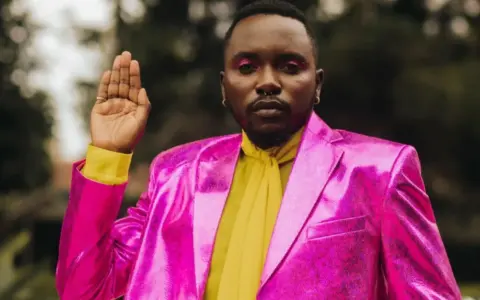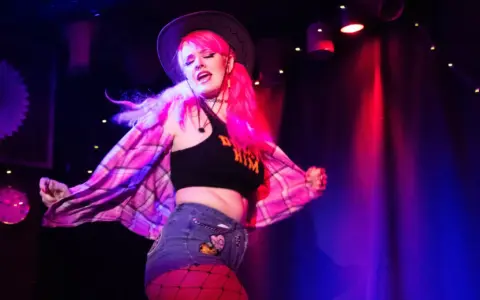
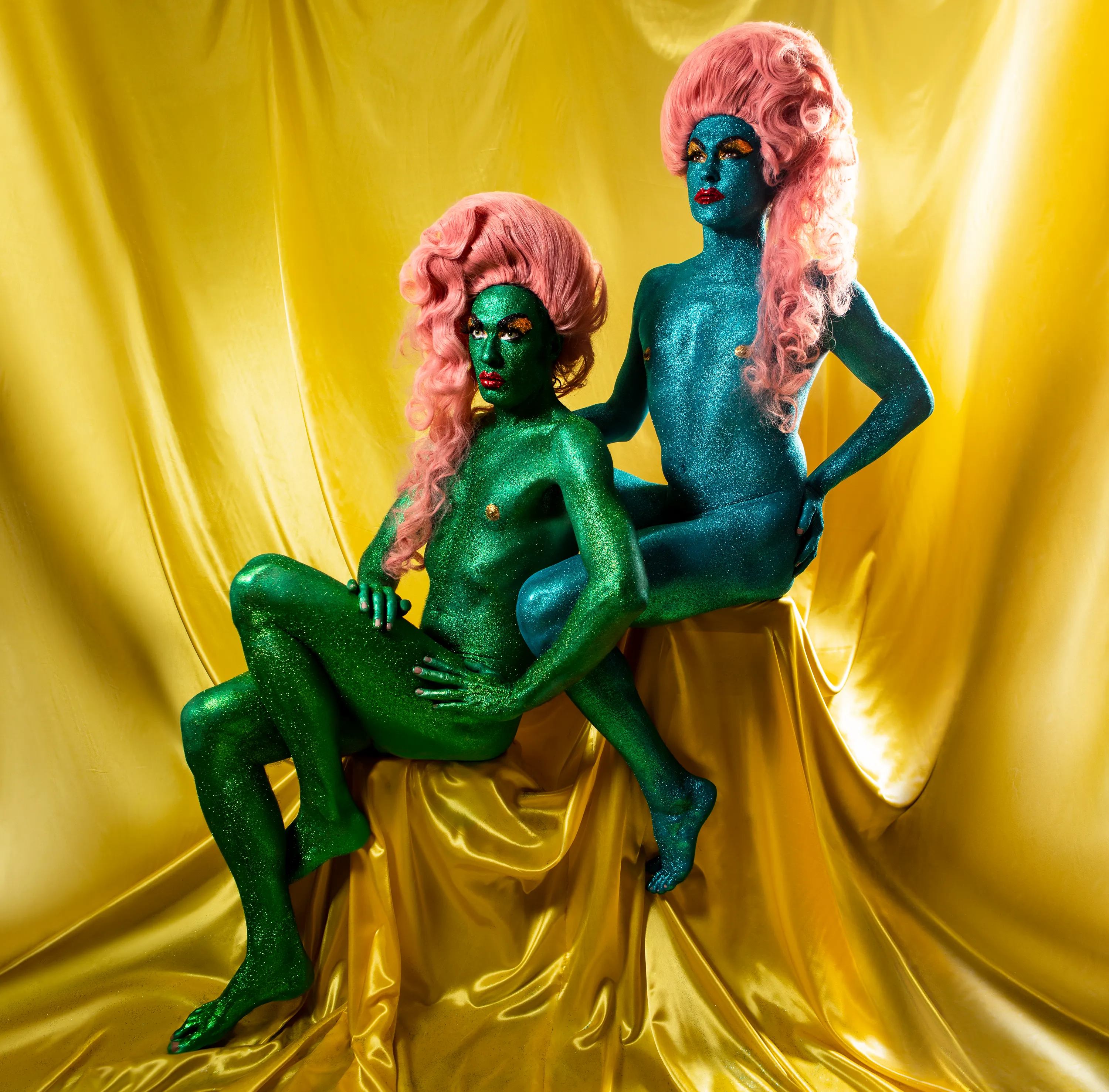
In the midst of Heroes and Taboos, Melbourne’s The Huxleys will host the House of Heroes: Late Night dance party, as part of the Super Kaylene Whiskey art exhibition at The National Portrait Gallery in Canberra on February 20.
Queer, hypnotic and super kitsch, who are these two humble, shy men, Will and Garrett Huxley aka The Huxleys, whose alter-egos shape-shift into an array of surrealist, colourful creatures and who play with taboos? Luscious, sexy and dripping with glittering taboos that emit a wonder-filled imagination of fun and frivolity, The Huxleys question all things considered ‘normal’ within a surrealist performance where ‘anything goes’.
CL: How do you plan to host the Portrait Gallery event, which also encompasses Yankunytjatjara artist Kaylene Whiskey’s art exhibition?
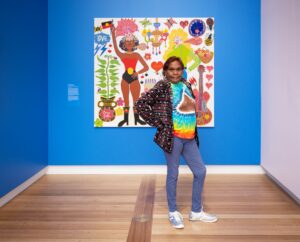
The Huxleys: “We met Kaylene at the Archibald Prize back in 2018 and it was love at first sight. We were completely in awe of her joy, her skill and her embrace of colour, popular culture, queer icons and the sacred beauty of her Anangu Culture. We love the same things! We love dressing up, embracing magic and the power of our creative heroes to help us soar. We believe Kaylene is what the world needs now, more than ever. We were actually her third choice to host after Dolly Parton and Cher were unavailable. We are delighted to be in such an esteemed company. We are going to be celebrating the music Kaylene loves and channeling joy, colour and dance into a night filled with incredible performers with a focus on queer, femme and First Nations’ artists. We want everyone to be the hero they dream of.”
The Huxleys challenge social norms by creating freaky fantasy worlds filled with glam-rock, pop-art and love. While on the flip side, they have dark and light shades of queer perception of gender, sexuality and erotica that nudge at the ideologies of the status quo. Will calls himself a shy extrovert and Garrett is an introvert, which is a strange combination. Both complement each other in the social disguising of their personal lives, which are lived through fantasy and spectacle, the costuming of the body.
CL: You embody and create so many different characters. I’m amazed at the rich detail and depth of each creature’s personality you create. Is this a form of self-protection, where you can trust in each other’s ideas and not give a fuck whether anyone likes it or not?
The Huxleys: “The costumes, makeup and art help us find a voice and a confidence that is often hard to find when you’ve grown up being bullied and ostracised just for being yourself. These costumes are like armour, like being your own glam rock hero. Growing up as queer boys in suburban homophobic places in the ‘80s and ‘90s was a challenge, but art was the escape. It was the protection, the fantasy that we would find a place we felt free and love and joy. Our art is what we call a ‘queer utopia’, where too much is seldom enough and where you can be whatever you dream of. Art is the answer. For many years we tried to get people to take notice of our art. The art world can be so serious and so exclusive and we just thought we can’t sit around waiting for people to give us permission; we are just going to put our work into the world and if people love it or hate it.. that’s their problem. We just encourage each other to keep being more ridiculous. We love this quote by Andy Warhol: “Don’t think about making art, just get it done. Let everyone else decide if it’s good or bad, whether they love it or hate it. While they are deciding, make even more art.”
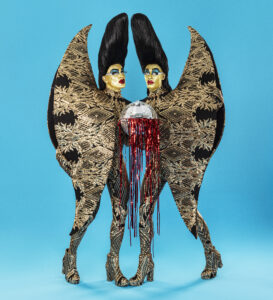
Doppelgangers of freaky intention. The Huxleys are an art gallery of iterations, living out their fantasies through performance art and a vehicle of conceptual art queerness. They sensationalise gender, sexuality, identity, culture, faith and consumerism and the politics of embodiment arts practice. I think it’s exciting to see the abundance of playful concepts pushing the boundaries of social taboos, where The Huxleys use the human form as a scaffold to reconstruct and reconfigure the notion of body as sculptural performance.
CL: Your video works are wonderful. They push the threshold of perversity and are filled with colourful, eye-popping pseudo-erotic splendour. Have your works been protested by conservative groups who may consider your art as blasphemous?
The Huxleys: “Yes, we’ve had video works banned, suggesting that they are sexually charged, which mainly just means they are ‘too queer’. We’ve had images censored and our performance work Born to Be Alive has been banned and attacked. In the work, we are born from a giant inflatable vulva we made and we worship this beautiful sacred space as a tribute to all the women we admire and love. We made it to combat sexism and misogyny. But it’s one of the works that people are most angry about, which goes to our point that misogyny is so prevalent in our culture. How anyone can be angry or repulsed by this completely alludes us. How do people think they were conceived or brought into this world? We have had people protest at Pride events in regional places where we have performed but we see it as our duty to take our message to places which may not be on board with it. Those are the people you can try and reach and change and get them to open their minds. Our message is always about love and freedom and joy for everyone.”
As collaborative art makers, The Huxleys can defy their fear of public outcry and rely on their love and strength for each other to stick together. The Huxleys seem to be care-free and intent on creating art that appeals to how they feel, as opposed to how the art world may see them. They carefully devise, perform and edit their works, which explore the realms of surrealist adult/child fantasy worlds of extreme psychedelia. The variety of their artworks creates a hypnotic stare, where sparkling figures dance, prance and spin in and out of psychedelic forests, transforming into creatures of bizarre exotic erotica. Their works are layered with taboos reminiscent of Hieronymus Bosch’s The Garden of Earthly Delights painting, especially in the right panel which depicts Hell.
CL: If you could play in the Garden of Earthly Delights – what would you be? A Goldfish for a head with the trunk of an elephant, attached to the neck of a giraffe with the body of a horny tarantula fucking the butt of a turtle?
The Huxleys: “We love dogs and we love Bowie, so we might be medieval diamond dogs. Dogs are pure animals who love unconditionally, they are inspirational. We often joke that our world is like Hieronymus Bosch going to Studio 54.”
CL: You have also performed in outdoor festivals, which are generally family-friendly. Your work As Camp as Christmas comes across as overtly gay and from a happy place that is non-threatening to masculinity. You mentioned the importance of laughter in your work to cross boundaries of difference. Could you elaborate on that?
The Huxleys: “Growing up, we often had to resort to humour as a protective device. If you could make the bullies laugh, you might save yourself from being beaten up. Humour is a way of disarming people. Once you make someone laugh, their guard is down and then you can depart your message of acceptance and embracing difference as a thing of joy that can make you smile. It’s like that old idea that a spoon full of sugar is the way to win someone over. If you come at people in a didactic angry way, it often makes you hit a wall. Even if you feel angry, which we often do about the state of the world, we find responding with more anger doesn’t work. It’s actually harder to be joyful and humorous but we find it reaches more people and brings light to the world, rather than more darkness.”
The Huxleys suffered homophobic abuse growing up as gay men. As artists, they can reverse the weaponisation of conservative masculinity and certify their affection for each other through love, trust and consent. It’s like watching a beautiful performative queer-art love story, played out in the public eye. The more I research the Huxley’s the more I think of the conceptual boundaries of arts practice that are being re-imagined.
CL: You mentioned the term ‘queer elders’ and standing on the shoulders of artists who have inspired you such as Leigh Bowery, David Bowie and Sylvester, and that you hope that your art inspires people. I personally think you do, but can you tell me about the story of the Hobart boy who was inspired by your art practice that he made his own costumes of your characters?
The Huxleys: “We often say we wouldn’t be here making our art if it wasn’t for all the incredible queer artists that came before us and fought to open these doors. History and queer ancestry is so important. We were in Hobart performing at Dark Mofo and were in a book shop and this beautiful mother and child came up to us and asked if we were The Huxleys. We said we were and the boy was so excited. His mother then told us that each year for book week he gets her to help him make a version of one of his favourite costumes of ours! He follows our work. It was such a beautiful moment and to see a mother so supportive and encouraging of her creative son was so special. If we can make anyone feel more free and more creative then that is a beautiful dream.”
CL: I showed a video of your works to a very straight, macho man friend of mine, and he said. “What a couple of poofta fairies – real blokes don’t do that”. I said to my bloke friend, “Maybe you’re restrained by the role of masculinity and trapped in stereotypes that represent how a real man should look and behave.” He looked again at the video and other works from Huxley’s website and then said. “OK, they are funny, and I sort of feel like a kid again watching a crazy cartoon.” There is a vibrant, energetic vision of imagination, brimming with untapped possibilities in your arts practice. As makers of queer conceptual performance art, do you consider yourselves as social provocateurs where people (men) may fear or get angry at your images of masculinity. Do you intentionally create work that provokes masculine stereotypes?
The Huxleys: “Growing up we never felt masculine. We’ve never identified with that traditional idea of masculinity, even though the athletic hetro-normative places we grew up in pretty much only presented that image. We’ve always defied that narrow vision of masculinity or gender. We love stepping outside of those binaries. There is so much freedom when you don’t need to prescribe to those ideas of what men or women should look or act like. When we were kids, it was called ‘androgynous’ and we were so lucky to see icons like David Bowie, Grace Jones and Boy George, to name a few; artists that played with gender and let you realise there was such a wider field of view out there. As a child if we even wore a pink shirt we got called ‘poof’ or ‘faggot’. So, I guess our work is getting revenge on narrow minded culture. We want to make work that is about total freedom. Many of the surrealists and Dadaists embraced that notion. You only have to look to the dreamscapes of someone like Leonara Carrington to see that the world can look and be whatever you dream of.. and it’s beautiful.”
The Huxleys are a force to be reckoned with as they create new ways to immerse multi-art forms, which collide in a swirl of imagery that loops inside an infinite array of ghoulish creatures. Acting out childhood fantasies, fables and myths that become a mantra of colourful tantrums, danced by two men in shiny lycra tights and their skin beautifully covered in tinsel. A quote from an ABC documentary sticks in my mind where Will says: “You can never have enough sequins – never”
CL: Is the aim of artists to shake and disturb the institutional foundations and dismantle the even playing field by shifting the goal posts to suggest new perceptions of differences?
The Huxleys: “Yes, we think art has to try and break open things, to show new perspectives, new voices. Life can be so prescribed and everyday life can be so dark and challenging. We think art needs to find ways of giving people an escape or a new mind set where they can marvel at the idea of difference as a thing of beauty, rather than to be fearful of it. So much of society is based on the idea of following what’s normal or safe and life would be so dull if everyone was like that. Artists can create alternatives and they are so important. Author Fran Lebowitz was asked why so many queer people are artists and she said it’s because queer people are so often made to sit outside of mainstream society so they become observers; they see so much more as they are often on the outskirts of things and that is why they can provide such important and beautiful perspectives that are so different from everyday culture. We really understand that idea.”
The Huxleys have a sensational ability to expose social doctrines and invert perceptions of gender, masculinity, faith and the pillars of governance. The Huxleys are a spirited duo, and their performative arts practice is outstanding and focused on inspiring each other through the joys and sorrows of being human.
CL: Can you add any final comments on what we might expect at the National Portrait Gallery party?
The Huxleys: “Expect radical joy and the power of art to make us smile. And maybe we can leave it to Bowie who sung,“Let’s dance, put on your red shoes and dance the blues”.
***
Be a House Hero and fly kaleidoscopically queer and high, kooky and bent, weird and wonderfully and party alongside the fabulous Huxleys as they present Yankunytjatjara artist Kaylene Whiskey’s exhibition, alongside a blockbuster line-up of artists and DJs.
Visit the Huxleys’ website HERE
Buy tickets to House of Heroes: Late Night at the National Portrait Gallery HERE