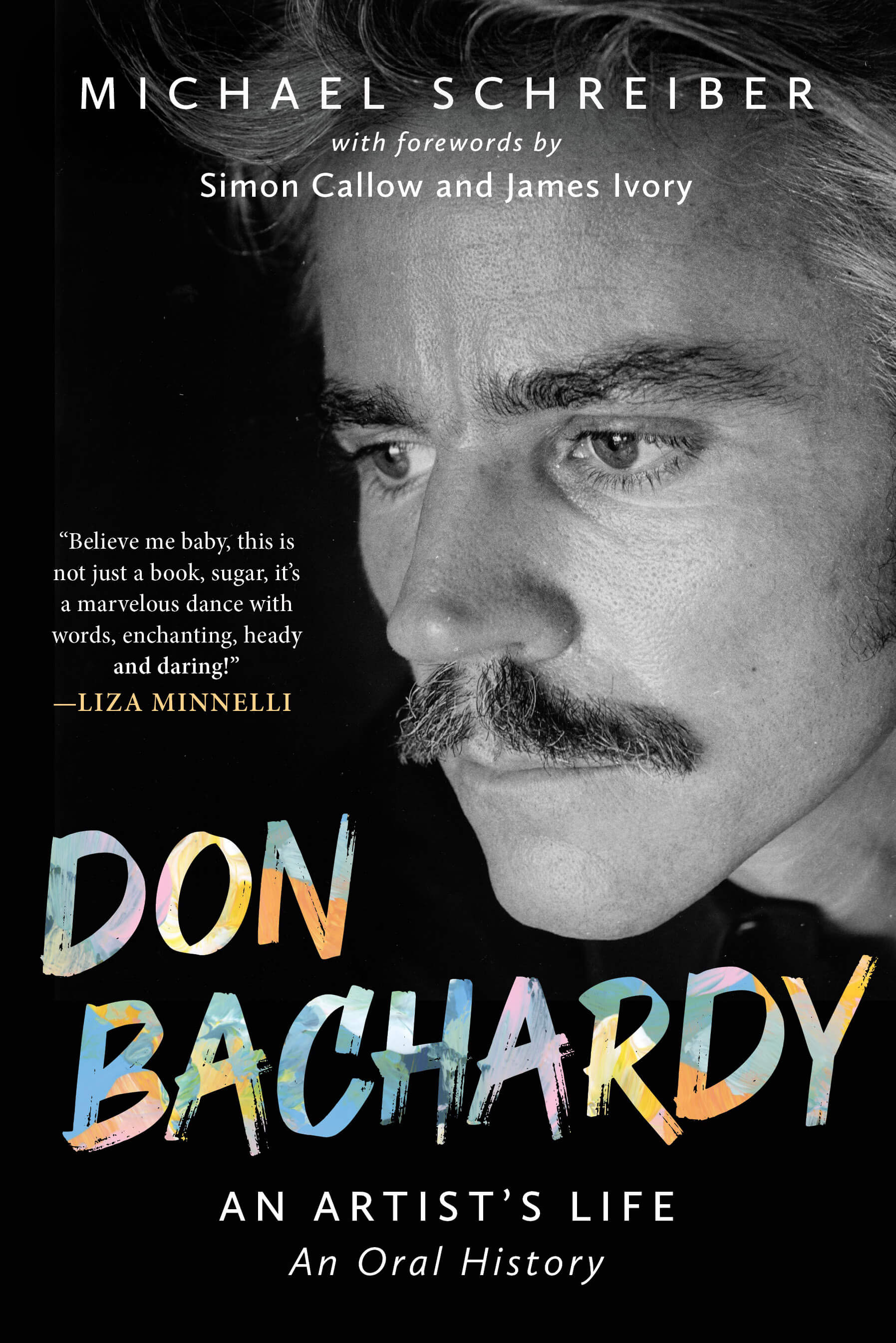

Don Bachardy: An Artist’s Life, An Oral History
By Michael Schreiber
Citadel Press Books © 2025
Available at https://www.amazon.com/Don-Bachardy-Artists-Michael-Schreiber
Reviewed by Christos Linou
4 ½ stars out of 5
Are the most beautiful people in cinema the ugliest?
The author Michael Schreiber has crafted an intimate transcription of documents, letters, photographs and recorded interviews, spanning over eight years with Hollywood’s portrait artist Don Bachardy. The book is written as a dialogue between two gay men discussing the love and affection of renowned writer Christopher Isherwood, who is credited for his novel ‘Goodbye to Berlin’, which was adapted for the film Cabaret. Schreiber sets up the narrative at the onset of the book and says:
“Their courageous pioneering advocacy as a fearless, openly gay couple in a fearfully buttoned-up mid-twentieth-century America.” p.29
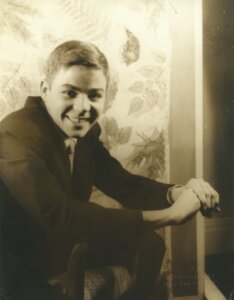
This is a gay love story that explores boundaries that were openly crossed in the entertainment industry. His partner, Chris, was the key to his success and played a crucial role in connecting him in a world where ‘It’s not what you know, it’s who you know’. Bachardy sincerely acknowledges that he would not have the life and successes without Chris. There is all one may expect from the glamour of Hollywood and its alluring magic of fame and fortune, along with the double-crossing, deceitful people who pretentiously harm and undermine another person’s hopes and dreams of the silver screen. Don Bachardy lets it rip and exposes stories of the stars he met:
“We were the only openly queer couple ever! Rock Hudson and all the rest of them avoided us like the plague.” p.132
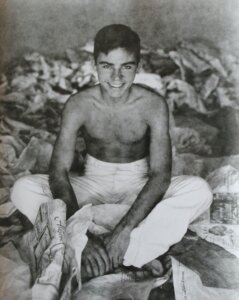
The author has shaped the biography of Don Bachardy into three sections, which explore the early years of the young artist stalking and photographing movie stars at red carpet events with his brother Ted. During this time, Bachardy established relationships with many of the women in cinema including Marilyn Monroe, Bette Davis, Joan Crawford, Lauren Bacall, Eva Gardner, Elizabeth Taylor, Natalie Wood, Judy Garland, to name a few!
“It was a screening solely for Hollywood people so Marilyn Monroe was there, Bogart and Bacall were there! So, you can imagine my ecstasy.” p.115

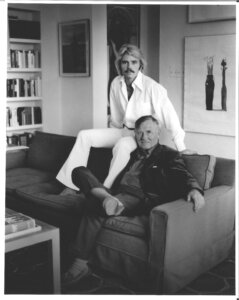
The middle section details his life at the age of nineteen and how he met Chris Isherwood, who was thirty years his senior. Their gay relationship caused a stir and controversy because of the difference in their age and their openness about being homosexual in conservative 1950s America.
“But here I was sleeping with Chris, who was somebody years older, more than thirty years older than I was – and I loved being with him.” p.49
The book honours the film culture of American life and the perspective of revealing one’s sexual preference against the backdrop of a conservative, fearful America. It covers all the delicate details of how two men influenced each other through the bonds of a loving gay relationship.
“He could tell me everything I wanted to know, and finally, my education for life began.. and I had the perfect teacher who made it fun, who made it exciting” p.50
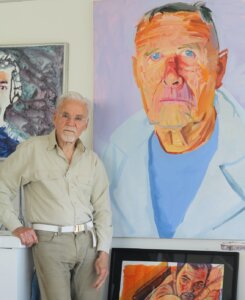
The ancient Greeks were committed to EROS, the God of Love, and they respected and honoured their love for one another regardless of gender and created portraits onto vases, walls, mosaics, sculpture and architectural monuments celebrating and glorifying the love of humanity. Homosexuality was not forbidden; rather, an elder man loving a younger man was considered an education for the younger lover/scholar.
“My father was just a lousy father but Chris was made for it. He became my father and just about everything else, my education.” p.56
The final part of the book discusses the artwork of Bachardy’s and how he drew the portraits of Hollywood’s elite. He describes genuine relationships with writers, directors, producers and the actors of Tinseltown; along with the gossip, envy, betrayal, vanity, pretentiousness and backstabbing that takes place to get to the top in the cut-throat industry of showbiz!
“Oh, there were certainly people who didn’t like us, didn’t like us appearing as a gay couple – at those big movie star parties, who murmured in the corner.” p.293
Both men played pivotal roles in the gay community during the golden age of Hollywood and, more importantly, during the 80’s HIV/AIDS crisis they were advocates for support and pride for the queer community. Sadly, it also covers the death of his partner Chris and discusses the intimacy of drawing him in the last six months of his life as he slowly died at home.
“Of course, I knew he was slipping away – it was also the most intense way of being with him, of looking at him. That’s really what I needed: that intense closeness, being with him.” p.300
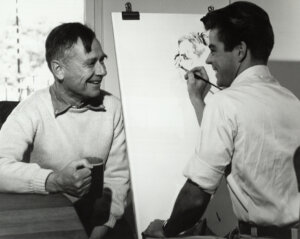
Bachardy talks about the challenges of becoming renowned for his portraiture of celebrities and was in demand by notable figures in pop music to politicians. He drew Nancy Regan, Linda Ronstadt, Elton John, David Hockney, Igor Stravinsky, Leonard Bernstein to the full cast of dancers from the New York City Ballet. The magnitude of Bachardy’s artwork is estimated to be over 17,000 portraits.
The book is filled with a ‘who’s who’ of the Golden Age of Hollywood movies and the stars discussed are of legendary status and icons from America’s silver screen. Bachardy’s partner, Chris, was a huge influence and introduced him to the A-list of Tinseltown. Throughout the book Bachardy’s references and thanks Chris for introducing him to famous people.
“I couldn’t be just his young, cute boyfriend; I know that wouldn’t be enough for either of us. So everything was riding on my establishing myself as an artist.” p.152
If you’re not familiar with the actors from the era from 1920 -1970, the name dropping becomes a slight blur unless you can picture the actors and the films they were in. The book is of interest when you can locate the films alongside the reading of the famous actors and get an insight into the subtle nuances that Bachardy describes about the actors. What struck me was the beautiful attention to detail in the portraits of the Hollywood stars that he has drawn. Something phenomenal emerges when a one-on-one artist and subject come together. The artist looks deeply into the eyes of the subject and carefully creates a remarkable likeness to the portrait of the person to reveal their emotional states of vulnerability.
“I don’t think any drawing done from a photograph can be interesting, because it’s not live.” p.62
Even though he was starstruck when he met famous and important people, Bachardy did not hold back on how he saw each person and how he would draw or paint them. This is the exciting area of interest in the reading of the stories: glamourous celebrities are also subject to the spoils and hardship of life. The veneer of lights, makeup, soft focus lenses and special effects isn’t enough to hide or disguise the essence of the person when they are being asked to sit for a live portraiture.
“My role as a portrait artist is similar to that of an executioner: I tell the truth, and that truth is the death of all hope, looking lovely. The Hollywood loveliness is a lie.” p.122
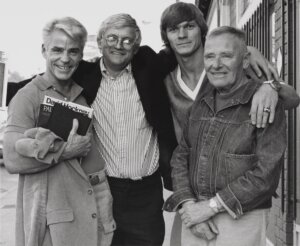
Bette Davis sat for him on several occasions, and being the fierce and adulterated veteran of Hollywood who would speak her mind, she was not always pleased with the drawings. In the final portraiture, Bachardy reflects:
“I remember her taking a long time, walking very slowly, and eventually getting behind me and there was a long pause, silence before she said: ‘Yup! That’s the old bag’.” p.258
Judy Garland may be a gay icon and a dream of somewhere over the rainbow, of gleaming innocent love, but behind the scenes was a spiteful, self-righteous and narcissistic person. Bachardy recollects moments where he and his partner, Chris, would hide inside their house to avoid a visit from Garland. She would be drunk and obnoxious, screaming out their names and vandalising plants, to get inside.
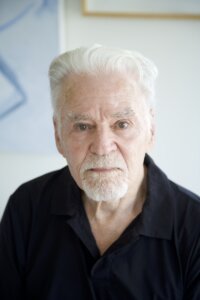
The essence underlying the sordid stories of insecure glamourous celebrities is the love story of Chris and Don and how they inspired and influenced each other’s life; being wise to the smiles and lies of fame and fortune and founding their position as a loving gay couple.
The author is a gay man in a loving relationship and the narrative is delivered with the subtleties and directness about homophobia in mid-century America. Schreiber raises probing questions, with detailed names and dates, in an open candour from one gay man to another gay man, as a way of unpacking Hollywood’s glamour and gossip with grace and humour.
The book is entertaining, especially when you use google to look up their names (Who was Elsa Lanchester?) Then you can understand the gossip that Bachardy talked about and get an idea of how the beauties and brats of Hollywood lied and cheated their way to the top.
It sounds like the great American dream.