‘Blitz: the club that shaped the 80s’
This exhibition ran from 20 September 2025 until 29 March 2026 at the Design Museum, London.
Reviewed by James Leon
The New Romantics burned bright and fast, carving out a brief but brilliant moment in the early 1980s. The movement emerged from a tiny club night beneath a Covent Garden wine bar, just as the drabness of the late 1970s gave way to something more theatrical, more defiant.
The Blitz only ran for 18 months, but its impact was wildly disproportionate to its lifespan. It became a petri dish for a scene that would heavily influence fashion, music, film, art and design throughout the decade that followed; and one which continues to the present day.
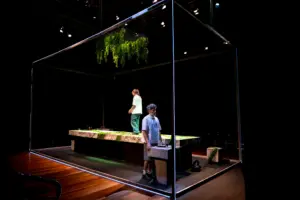
There’s been no shortage of retrospectives on this era, many orbiting the now-mythologised club. But the recent exhibition at the Design Museum London offered something different: the chance to step inside the world, rather than simply read or watch a documentary about it.
Developed in collaboration with some of the original ‘Blitz Kids’, the show brought together over 250 objects—clothing, accessories, sketches, instruments, flyers, magazines, furniture, photography and rare film. At its centre was an immersive reimagining of the club itself, complete with bar, dancefloor, and a digital avatar of DJ and co-founder Rusty Egan, alongside newly remastered footage of an early performance by Spandau Ballet.
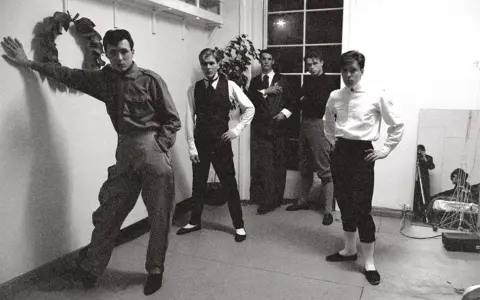
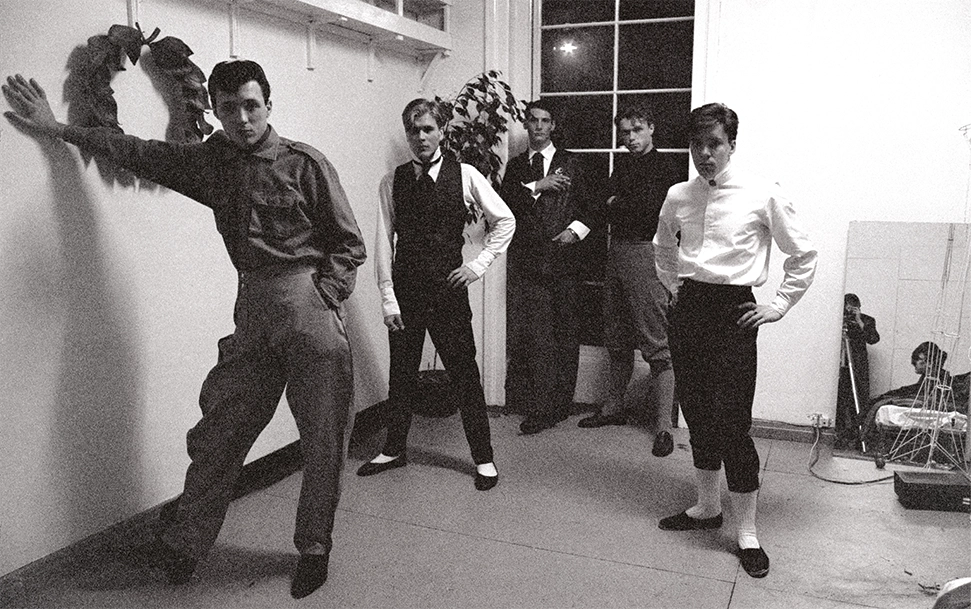
Spandau were the only band to play live at the Blitz (before breaking into the mainstream and becoming global superstars with songs like True) and became the ‘house band’. Their look and sound were shaped by fellow club regulars—lighting designer Simon Withers, graphic designer Graham Smith, and a wider creative network that blurred the boundaries between disciplines.
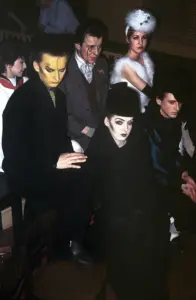
Rising from the ashes of punk, the Blitz scene was built by young, largely working-class creatives—self-styled dandies who transformed dressing up into an art form. What we now recognise as queer culture was intrinsic to the scene. The crowd was mixed, but traditional boundaries of gender and sexuality were blurred with dazzling creativity: heavy make-up, frilled shirts, and theatrical self-invention were de rigueur.
Figures like Boy George, then working the cloakroom—and Marilyn—embodied the club’s playful approach to gender. Meanwhile, females also played with imagery, with some sporting military jackets and severe, angular hair styles.
The night itself, running on Tuesdays from 1979 to late 1980, was the brainchild of Steve Strange and Egan. Strange, an enigmatic gatekeeper, enforced a famously strict door policy: entry depended on your look, a look that had to embody a particular kind of flamboyant non-conformity.
Inside, Egan’s DJ sets—drawing on the likes of Roxy Music, David Bowie and Kraftwerk—laid the groundwork for the synth-driven sound that would define the incoming decade.
Music producer Richard James Burgess coined the term ‘New Romantic’ to describe the Blitz kids and their accompanying scene. Similar club nights such as the one at Birmingham’s Rum Runner were soon sprouting up around the UK; alongside a profusion of bands like Duran Duran and Soft Cell, embodying the aesthetic and sound emanating from The Blitz.
Strange himself – another individual of ambiguous sexuality – would later front Visage, whose track Fade to Grey quite possibly remains the scene’s signature tune. Its icy, stylised video—shown here alongside stills from Ultravox’s Vienna, Spandau’s The Freeze, and Bowie’s Ashes to Ashes—captures the aesthetic at its most distilled.
The Blitz’s guestlist, informal though it was, reads like a cultural roll call. Sade was a regular, as was Siobhan Fahey of Bananarama and Shakespeare’s Sister. Beyond music, figures like milliner Stephen Jones and a young John Galliano passed through its doors, absorbing and contributing to its visual language.
The exhibition’s attempt to recreate the club environment was effective, if somewhat pedestrian. For a scene defined by excess and spectacle, the technological elements felt a little underpowered, and the relatively small selection of garments on display didn’t quite match the flamboyance captured in the archival imagery.
Where the show truly excelled, though, was in its contextual framing of the scene within the socio-political landscape of the time. Wall texts in the opening section depicted a London that feels almost unrecognisable now: economically depressed, physically scarred, yet paradoxically full of possibility.
Parts of the city still lay in post-war disrepair (unbelievably); yet housing was cheap and in plentiful supply (many young people lived in social housing or squats – which were commonplace in London at the time), student grants were accessible and living on the dole was a viable option for many young people.
That combination of material scarcity paired with relative freedom, in stark contrast to London and many other cities today, created the conditions for something explosive. For a brief moment, young (largely working-class), creatives had the time, space and social elasticity to invent themselves, and in doing so, helped to reshape culture.
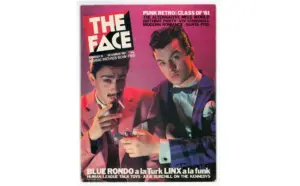
The exhibition also tracks how that influence spread, notably through the explosion of style and music magazines like The Face and i-D. Their pages—filled with fluorescent make-up, gender-play, and slyly subversive slogans—capture a queer-coded aesthetic that would soon filter into the mainstream.
Nostalgia is always a risky lens, but it’s hard not to feel a pang here. The Blitz wasn’t just a club—it was a convergence of timing, economics, creativity and attitude that feels impossible to replicate now.
Oh, to have been there, even for just one Tuesday night.